
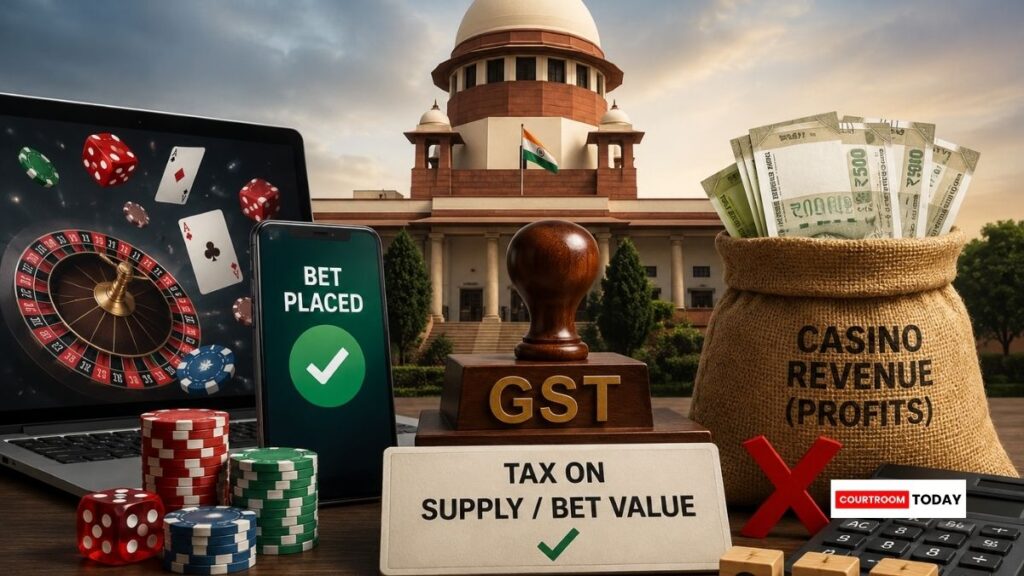
In Directorate General of Goods and Services Tax Intelligence HQs v. Gameskraft Technologies Private Limited, the Supreme Court has clarified that GST on casino gambling activities must be calculated on the value of bets placed by players and not on the profits retained by casinos after paying winnings. The ruling forms part of the Court’s wider judgement upholding the levy of GST on online gaming, fantasy sports, and other games involving stakes on uncertain outcomes.
A Bench of Justice J.B. Pardiwala and Justice R. Mahadevan rejected the argument advanced by casinos that GST should be levied only on Gross Gaming Revenue (GGR), which refers to the amount a casino retains after deducting winnings paid to players. Casinos had contended that if players collectively won more than they wagered, there would effectively be no taxable consideration and, therefore, no GST liability on those transactions.
The Supreme Court disagreed with this approach and held that GST is a tax on a taxable supply and not on the profits or losses earned by a business. The Court observed that the taxable event occurs the moment a player places a bet on an uncertain outcome and is allowed to participate in the gambling activity. Therefore, tax liability cannot depend on whether the casino ultimately earns a profit or incurs a loss at the end of a gaming cycle.
The judgement noted that the foundation of the GGR model is inconsistent with the structure of the GST regime. According to the Court, consideration arises when a player stakes money for participation in gambling activities. Once the bet is placed, the taxable supply is complete, making subsequent wins or losses irrelevant for determining GST liability.
The Bench also rejected the contention that casino transactions conducted through chips or tokens do not create a taxable supply. It explained that players cannot participate in casino games without first purchasing chips or tokens, which merely act as a medium for placing bets. The taxable event remains the staking of money on an uncertain outcome and not the eventual result of the game.
The Court further observed that accepting the casinos’ argument would make the existence of taxable consideration dependent on whether players won or lost. Such an interpretation, it said, is legally unsustainable because the gambling activity remains the same regardless of the outcome. A player’s winnings or losses cannot erase the taxable supply that already occurred when the bet was placed.
Highlighting the practical implications, the Court stated that a profit-based taxation model could potentially allow manipulation of tax liability through adjustments of winnings and losses. The GST framework, however, taxes supplies and not business profitability. For this reason, the Court concluded that GST must be levied on the value of bets placed by players rather than on the net revenue retained by casinos.
The ruling is expected to have significant implications for the taxation of casinos, online gaming platforms, and fantasy sports operators, reinforcing the principle that GST liability arises at the point of participation in betting and gambling activities.
——————————————–
Have a case update, article, or deal to share? Courtroom Today welcomes contributions from lawyers, law firms, and legal professionals. Write to contact@courtroomtoday.com