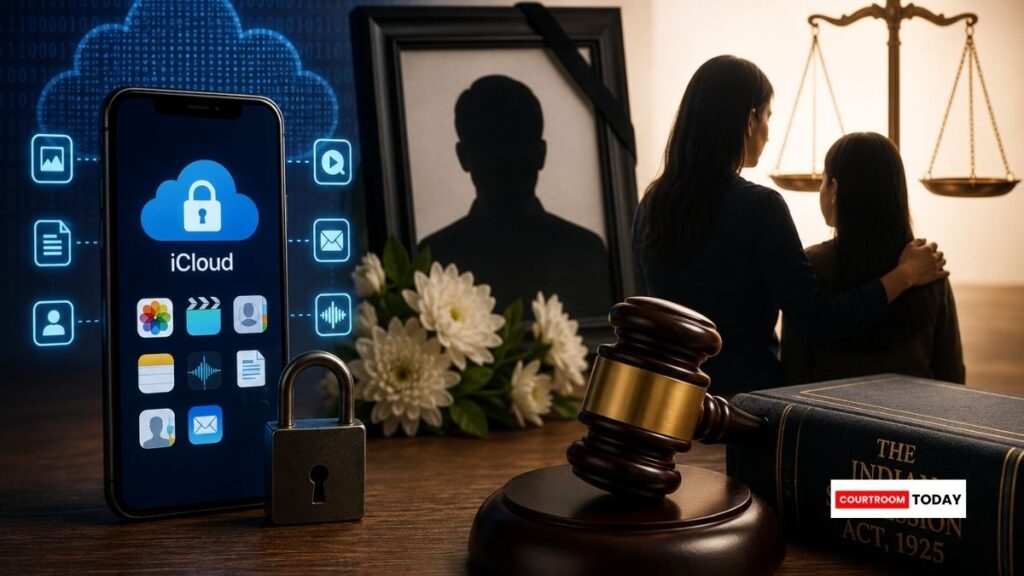
In Smt. Sadhna Shaishav Shah & Anr. v/s NIL, a Civil Court in Gandhinagar has ruled that the right to privacy does not continue after a person’s death and that legal heirs can administer the deceased person’s digital assets, including data stored in cloud accounts.
The case was filed by the wife and daughter of a man who died intestate on April 24, 2025, in Gandhinagar. The deceased had not left behind any will or testamentary document. The petitioners approached the court seeking recognition of the digital data stored in his Apple iCloud account as part of his estate under the Indian Succession Act.
The family argued that the iCloud account contained important photographs, videos, voice notes, documents, and contact details that carried emotional, sentimental, and practical value. They requested the court to grant them Letters of Administration so they could legally manage and recover the digital estate.
During the proceedings, Apple informed the court that it could assist in resetting the password or security credentials to enable access to the iCloud account. However, the company stated that it could not recover data stored only on the physical device without proper legal authority.
Apple further clarified that access could only be provided to a legally recognised administrator or representative of the deceased’s estate supported by a court order containing specific declarations.
3rd Additional Senior Civil Judge Himanshu Choudhary observed that digital data stored in cloud accounts forms part of the estate of a deceased person and can therefore be administered under succession laws.
The court relied on the Supreme Court’s judgement in Justice K.S. Puttaswamy v. Union of India (2017) while discussing privacy rights. It held that privacy is a personal right that ends with the death of an individual.
The court stated:
“This Court is of the considered opinion that the right to privacy, being an inherently personal right, does not survive the death of the individual.”
The court also referred to the legal maxim actio personalis moritur cum persona, meaning personal rights and claims die with the person. It observed that no privacy claim could be used to prevent lawful heirs from administering the deceased’s digital estate.
Further, the court noted that no nominee had been appointed by the deceased under Section 14 of the Digital Personal Data Protection Act, 2023. In such circumstances, the rights concerning management and access to digital data would naturally pass to the legal heirs for the limited purpose of estate administration.
The court ultimately appointed the deceased’s daughter as the administrator of the estate. It directed Apple Distribution International Limited and its affiliates to assist in recovering the deceased’s iCloud data and to provide technical assistance, wherever feasible, for recovering locally stored data from the device.
——————————————–
Have a case update, article, or deal to share? Courtroom Today welcomes contributions from lawyers, law firms, and legal professionals. Write to contact@courtroomtoday.com