High Courts Back Three-Year Practice Rule for Judicial Service, Suggest Limited Relief for Disabled Candidates
The Supreme Court is currently examining review petitions in Bhumika Trust v. Union of India and connected cases, which challenge the mandatory three-year practice requirement at the Bar for entry-level judicial service posts. Several High Courts have now submitted their views on whether the rule should be relaxed for specially abled candidates.
The matter arises from the Supreme Court’s judgement dated May 20, 2025, which restored the requirement that candidates must have at least three years of practice as advocates before applying for Civil Judge (Junior Division) posts. The Court is now reviewing whether this condition should be modified for persons with disabilities.
The suggestions from High Courts were placed before the Supreme Court through a compilation filed by amicus curiae Senior Advocate Siddharth Bhatnagar. The bench comprising Chief Justice of India Surya Kant, Justice K Vinod Chandran and Justice AG Masih is scheduled to hear the review petitions.
According to the compilation, ten High Courts have submitted their views so far, and all of them broadly support the continuation of the three-year practice requirement as an essential eligibility condition for judicial service.
Several High Courts stressed that practical experience at the Bar plays a crucial role in preparing candidates for the responsibilities of the judiciary. They observed that courtroom exposure helps develop professional maturity, understanding of legal procedures and familiarity with the functioning of the Bench and Bar.
The Delhi High Court informed the Supreme Court that the Delhi Judicial Service Rules, 1970 were amended in February 2026 to reintroduce the three-year practice requirement. Its Rules Committee supported maintaining uniform eligibility criteria to avoid disparity among candidates.
Similarly, the Gauhati High Court noted that legal practice helps young lawyers develop practical skills and a better understanding of courtroom dynamics. The Odisha High Court also resolved that eligibility conditions should remain uniform across all categories of candidates.
The Punjab and Haryana High Court’s Rules Committee highlighted that entry-level judicial officers decide matters affecting life, liberty and property. It stated that such responsibilities require prior courtroom experience, including exposure to evidence, procedure and drafting judicial orders.
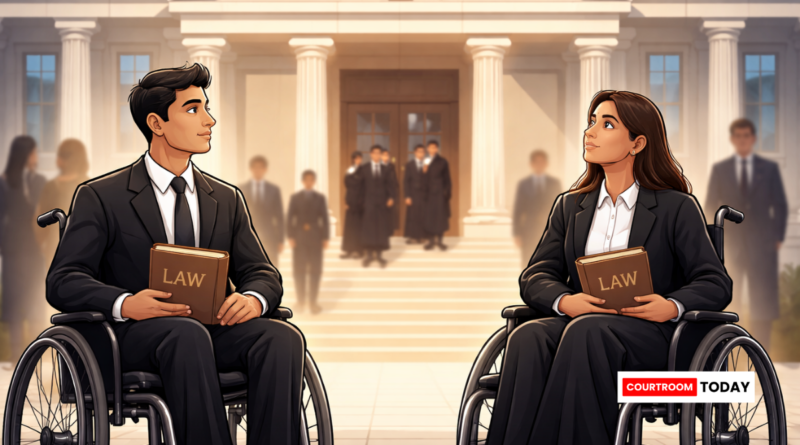
However, some High Courts suggested limited relaxation for candidates with disabilities. The Meghalaya High Court proposed reducing the required practice period or granting age relaxation of three to five years for specially abled candidates rather than completely removing the requirement.
The Tripura High Court went further and supported dispensing with the three-year practice rule for such candidates. At the same time, the Chhattisgarh High Court and a committee of the Jammu and Kashmir and Ladakh High Court maintained that eligibility conditions should remain unchanged even for persons with disabilities.
Law universities and colleges have also offered differing perspectives. The National Law School of India University suggested that institutional training for judicial recruits could reduce the need for mandatory pre-service practice.
Meanwhile, a survey conducted by Rajiv Gandhi National University of Law indicated that nearly 72 percent of respondents opposed the mandatory rule. The university suggested strengthening judicial training programmes and probation systems instead of enforcing a fixed practice requirement.
The Supreme Court will now consider these varied submissions before deciding whether the three-year practice mandate should continue unchanged or be modified for specially abled candidates.
——————————————–
Have a case update, article, or deal to share? Courtroom Today welcomes contributions from lawyers, law firms, and legal professionals. Write to contact@courtroomtoday.com