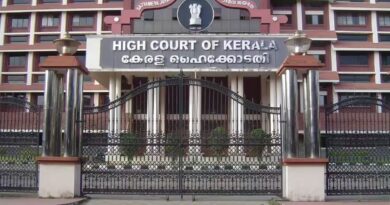

Kerala High Court Allows Haal Release With Two Cuts, Quashes Remaining CBFC Demands
The Kerala High Court on Friday granted partial relief to the makers of the Malayalam film Haal, amid the ongoing dispute over the film’s certification and the cuts suggested by the Central Board of Film Certification (CBFC).
A Bench led by Justice VG Arun set aside the CBFC’s decision that required the filmmakers to accept six compulsory cuts before granting only an ‘A’ (Adults Only) certificate. However, the Court directed the filmmakers to carry out two specific modifications before approaching the CBFC again.
Cuts Made Mandatory by the Court
The Court asked the makers to implement the following CBFC-suggested changes:
- Delete the scene showing beef biriyani being consumed, remove dialogues that allegedly demean certain cultural organisations, and blur any visible ‘rakhi’.
- Remove a dialogue: “Adhil thanne… matha thilekkumii kanu…”
After making these two changes, the filmmakers can re-submit the film for certification. The CBFC has been instructed to reconsider the application within two weeks.
Justice Arun had personally viewed the film to understand the relevance of the CBFC’s objections before issuing the order.
Other Suggested Cuts Not Accepted by Court
The remaining four changes proposed by the CBFC—which the Court did not insist on—included:
- Removing a song in which the lead actress appears in Muslim attire.
- Deleting scenes that allegedly stereotype certain communities.
- Blurring the name “Holy Angels” of an institution shown in the film.
- Removing dialogues that may affect Christian sentiments and altering scenes involving the Thamarassery bishop.
The film revolves around an interfaith love story between a Muslim boy and a Christian girl, which became the centre of the certification dispute.
Arguments Before the Court
The filmmakers—represented by Senior Advocate Joseph Kodianthara—argued that:
- The CBFC failed to consider the film’s overall message.
- The movie does not contain violence, explicit scenes, or content that warrants an ‘A’ certificate.
- The suggested cuts lacked logical reasoning.
The CBFC, represented by the Additional Solicitor General ARL Sundaresan, defended its decision by stating that the film crossed a “Lakshman Rekha” by touching upon matters sensitive to two religious communities. According to the CBFC, some scenes may cause “unease” and potentially disturb public order.
Justice Arun questioned whether mere “unease” could be a legally valid ground for censorship.
Objections by Religious and Social Groups
Two different groups also approached the High Court with objections:
1. Catholic Congress (Thamarassery Diocese)
The organisation claimed that:
- The film falsely portrayed the Thamarassery Bishop as supporting an interfaith relationship.
- It promoted “love jihad”.
- It altered the heroine’s religious identity—from “Mariya Fernandez” to “Maria Asif Kadalundi”—to normalise conversion.
- Some scenes showed nuns and hostel authorities in a negative light.
2. RSS Office-Bearer
Anil MP, an RSS functionary, alleged that:
- The film contains defamatory references to the RSS.
- It promotes anti-national and religiously divisive themes.
- It violates the Cinematograph (Certification) Rules, 2024, making it unsuitable for certification.
——————————————–
Have a case update, article, or deal to share? Courtroom Today welcomes contributions from lawyers, law firms, and legal professionals. Write to contact@courtroomtoday.com