
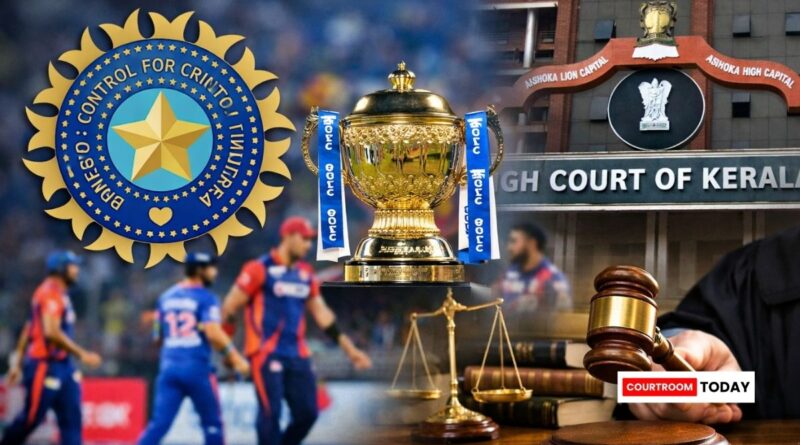
Kerala High Court Rejects PIL Challenging IPL Name Usage by BCCI
The Kerala High Court in Ashique Karoth v Union of India & ors has dismissed a Public Interest Litigation challenging the use of the name “Indian Premier League” by the Board of Control for Cricket in India (BCCI). The Court found the petition to be without merit and not fit for consideration.
The petition was filed by a social worker who argued that the Indian Premier League (IPL), being a franchise-based T20 tournament organised by the BCCI, was not an officially recognised national tournament. On this basis, it was claimed that the use of the term “Indian” was misleading and unlawful.
The petitioner relied on documents to support the claim that the BCCI is not recognised as a National Sports Federation by the Union Ministry of Youth Affairs and Sports. It was also argued that BCCI’s own Memorandum of Association treated IPL as a private tournament.
Based on these arguments, the plea sought a direction to restrain the BCCI from using the term “Indian Premier League.” The petitioner contended that such usage created a false impression of official national status.
However, the Bench comprising Chief Justice Soumen Sen and Justice Syam Kumar VM did not accept these submissions. The Court observed that the IPL has been conducted for several years and has gained wide public recognition during this time.
The Court was particularly critical of the delayed challenge raised by the petitioner. It noted that a belated realisation regarding the use of the term “Indian” could not justify invoking the Court’s jurisdiction under public interest litigation.
“The said tournament is continuing for several years and it is now stated that the petitioner recently realised that the IPL is not an official Cricket tournament of the Country and as such the use of the name Indian Premier League is illegal as used by the Board of Control for Cricket. We find no merit in the substance of the said argument and hence we do not feel that it would be proper to keep this writ petition as a Public Interest Litigation,” the Court said.
The Court ultimately held that the petition lacked substance and dismissed it without granting any relief. It emphasised that public interest litigation cannot be used to raise issues that lack genuine public concern or are brought after an unreasonable delay.
The decision reinforces judicial caution in entertaining PILs that challenge long-standing practices without strong legal grounds. It also highlights the importance of timely action and substantive merit in invoking constitutional remedies.
——————————————–
Have a case update, article, or deal to share? Courtroom Today welcomes contributions from lawyers, law firms, and legal professionals. Write to contact@courtroomtoday.com