Legal Heirs Entitled to Medical Reimbursement: Allahabad High Court Clarifies Rule 16
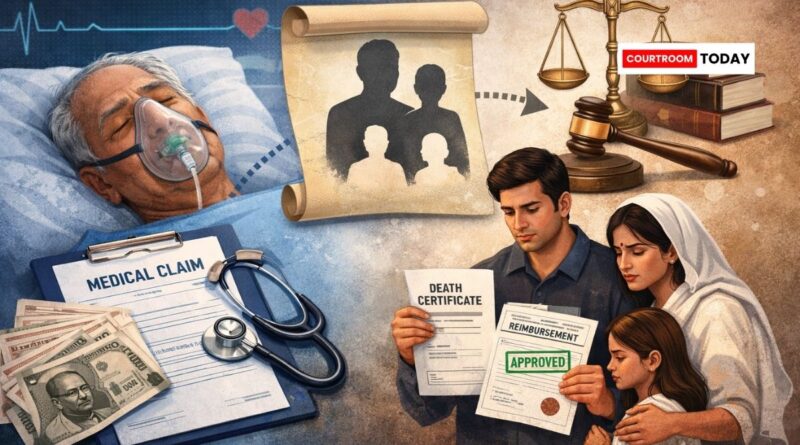
The case of Chandra Choor Singh v. State of U.P. deals with an important issue under the Uttar Pradesh Government Servant (Medical Attendance) Rules, 2011. The Allahabad High Court clarified that legal heirs can claim medical reimbursement if the beneficiary dies or is unable to file the claim.
The matter arose when the petitioner sought reimbursement for medical expenses incurred during his father’s prolonged illness. His father, a retired Deputy Registrar, had undergone treatment but passed away before submitting the claim. The authorities rejected the request on the grounds that only a “beneficiary” could file such claims.
Under Rule 3(b) of the Rules, a “beneficiary” includes government servants, retired employees, and their families. Rule 16 further requires that claims for medical reimbursement must be submitted within three months of treatment completion by the beneficiary.
However, the petitioner was denied reimbursement because he was considered a legal heir and not a beneficiary. Even after approaching the U.P. State Public Services Tribunal and receiving directions for reconsideration, the claim was again rejected on the same basis.
The High Court examined whether such a strict interpretation would defeat the purpose of the law. The bench of Justice Alok Mathur and Justice Amitabh Kumar Rai noted that the Rules did not address situations where the beneficiary dies or becomes incapacitated before filing a claim.
The Court observed that denying reimbursement in such cases would frustrate the objective of a beneficial legislation meant to support government employees and their families. It emphasised the need to interpret the Rules in a way that ensures fairness and practical application.
“…applying the principles of ‘reading down’, we hold that the provisions of Rule 16 of the Rules, 2011 should be read down so as to include the submission of a claim even by the legal heirs of the beneficiary where the beneficiary dies or is incapacitated from submitting the reimbursement claim himself and there is no other surviving beneficiary.”
Applying this principle, the Court expanded the meaning of “beneficiary” under Rule 16 to include legal heirs in specific situations. This interpretation ensures that families are not deprived of legitimate claims due to procedural limitations.
The Court also held that restricting claims only to beneficiaries was arbitrary and violated Article 14 of the Constitution. It further clarified that obtaining a succession certificate should not be made mandatory where there is no dispute regarding legal heirship.
“…a person should not be forced to obtain a succession certificate declaring him to be a legal heir in a situation where no such dispute exists.”
Accordingly, the High Court allowed the writ petition and granted relief to the petitioner. The judgment sets an important precedent by ensuring that technicalities do not defeat the purpose of welfare legislation.
This ruling strengthens the rights of families of deceased or incapacitated government employees. It ensures that financial relief in the form of medical reimbursement remains accessible even after the death of the original beneficiary.
——————————————–
Have a case update, article, or deal to share? Courtroom Today welcomes contributions from lawyers, law firms, and legal professionals. Write to contact@courtroomtoday.com