Madras HC Upholds Secularism: Hindu Man Allowed to Hold Annadhanam in Christian-Majority Village
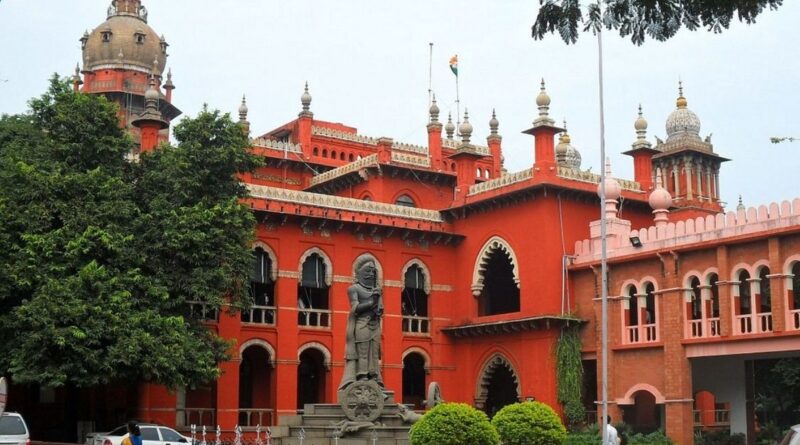
The Madras High Court recently came down strongly on a Tahsildar who denied permission to a Hindu man to conduct Annadhanam (community food distribution) on a public ground in a Christian-majority village. The officer had claimed that allowing the event could cause law and order issues, as the ground had been used only by Christians for over a century.
Justice GR Swaminathan, presiding over the Madurai Bench, reminded the authorities that India is a secular country and government property must be open to all communities without discrimination.
“If a public ground belonging to the State is open to the public, no group can be excluded based on religion. Doing so would violate Article 15 of the Constitution,” Justice Swaminathan stated in his order on October 31.
Court Rejects “Pre-Constitution Agreement”
The Court dismissed a Christian respondent’s claim that an old 1912 agreement allowed only Christians to use the site and that a 2017 peace meeting had reaffirmed it. The judge said that any such “pre-Constitution arrangement” has no legal value today if it goes against constitutional principles.
“We are a secular, democratic republic. The Constitution came into effect in 1950. Any old arrangement contrary to constitutional values cannot continue,” the judge said.
Justice Swaminathan made it clear that the ground must either be available to all communities or to none. He also pointed out that the Annadhanam was not planned during Easter, when Christians use the ground, but on November 3, a time when the site was otherwise free.
Equality in Access to Public Spaces
The petitioner, K Rajamani, had applied to use the ground near the Kaliyamman Temple for Annadhanam as part of the temple’s Kumbabisekam (consecration) ceremony. The Tahsildar initially permitted the event at a different site, which Rajamani challenged before the Court.
The Court allowed Rajamani to use the original site and quashed the Tahsildar’s refusal, emphasising that all citizens have equal rights to access public property, regardless of religion.
Justice Swaminathan also cited a previous judgment where the High Court permitted the establishment of a Bible study centre, holding that mere “law and order apprehensions” cannot override the right to practise and propagate religion under Articles 25 and 26 of the Constitution.
“The same principle applies here — if a Bible study centre can be allowed, Annadhanam during Kumbabisekam should also be permitted,” the Court noted.
Judge Calls for Religious Harmony
The Court expressed disappointment over the community tension surrounding the issue, noting that there were around 2,500 Christian families and only about 400 Hindu families in the village. The judge said such imbalance might have influenced the police’s concerns about disturbances.
“It is a very sorry state of affairs. In every religious event, there must be participation from people of other faiths. When a Christian friend celebrates Christmas, I should greet him first,” Justice Swaminathan remarked.
He further shared a personal memory from Ramzan, recalling how a Muslim friend once served him only vegetarian Nonbu Kanji out of respect for his dietary choices.
“Such gestures reflect the beauty of our culture. These interactions build inter-religious harmony. Without this sense of unity, true peace in society cannot exist,” he added.
Legal Representation
Advocate P Manikandan appeared for the petitioner, K Rajamani.
Special Government Pleaders P Subbaraj and M Lingadurai represented the Hindu Religious Charitable Endowment and the Tahsildar, respectively.
Government Advocate A Albert James appeared for the local police, while Advocate A John Vincent represented a private respondent, Suresh Perkmans.
——————————————–
Have a case update, article, or deal to share? Courtroom Today welcomes contributions from lawyers, law firms, and legal professionals. Write to contact@courtroomtoday.com