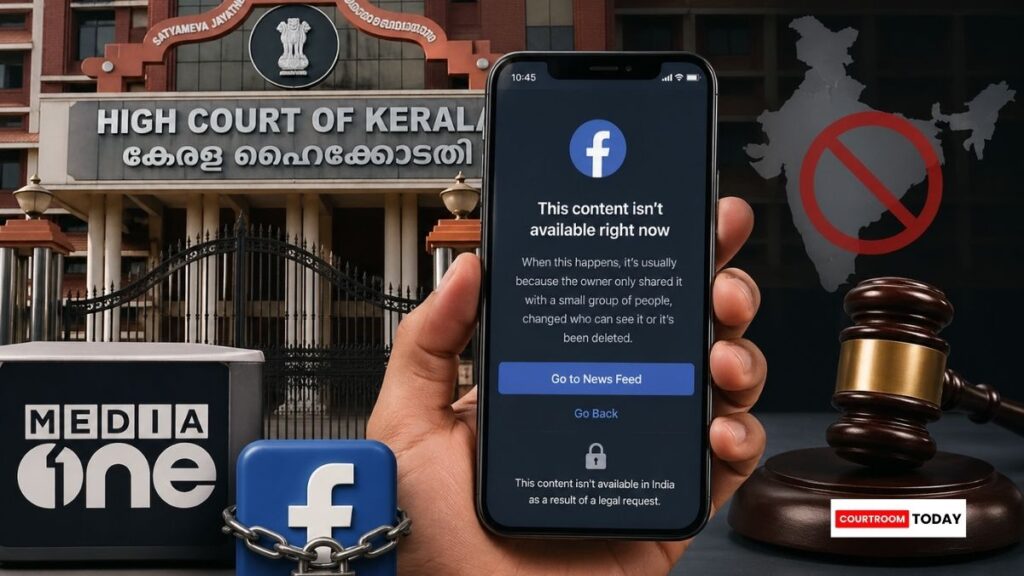
The Kerala High Court in Madhyamam Broadcasting Limited v Facebook India Online Service Private Limited and Ors. has issued notice on a plea challenging the blocking of MediaOne’s Facebook page in India. The matter raises serious concerns about digital censorship and procedural safeguards under law.
The case came before Justice K.V. Jayakumar, who directed the Central government and Meta to respond by filing counter affidavits. The petitioner, Madhyamam Broadcasting Limited, claims its Facebook page became inaccessible in India on April 23, 2026, without prior warning.
According to the broadcaster, the restriction followed a notification citing action under Section 79(3)(b) of the Information Technology Act, 2000. However, it argues that this provision does not grant independent authority to block content or entire pages.
The petition highlights that the Facebook page has been active since 2011 and plays a key role in sharing news content. It also states that the disruption has caused significant financial losses, with estimated monthly revenue of around ₹25 lakh affected.
A central issue raised is the absence of any disclosed order under Section 69A of the IT Act. The petitioner claims that no reasons were provided, and no opportunity of hearing was given before taking such action.
Relying on the Supreme Court’s ruling in Shreya Singhal v. Union of India, the petitioner argues that content blocking must follow due process. The judgement clarified that intermediaries can act only upon valid court orders or lawful government directions under Section 69A.
The plea also questions the legality of blocking an entire page instead of specific content. It contends that such a blanket restriction is excessive and goes beyond what is permitted under the Blocking Rules, 2009.
Further, reference is made to the Information Technology (Intermediary Guidelines and Digital Media Ethics Code) Rules, 2021. These rules require that blocking measures be precise and limited, rather than affecting entire platforms or accounts.
The petitioner has also claimed violation of fundamental rights under Articles 14, 19(1)(a), and 19(1)(g) of the Constitution, along with property rights under Article 300A.
The Kerala High Court has now sought responses from the authorities and scheduled the matter for further hearing on May 5, 2026.
——————————————–
Have a case update, article, or deal to share? Courtroom Today welcomes contributions from lawyers, law firms, and legal professionals. Write to contact@courtroomtoday.com