
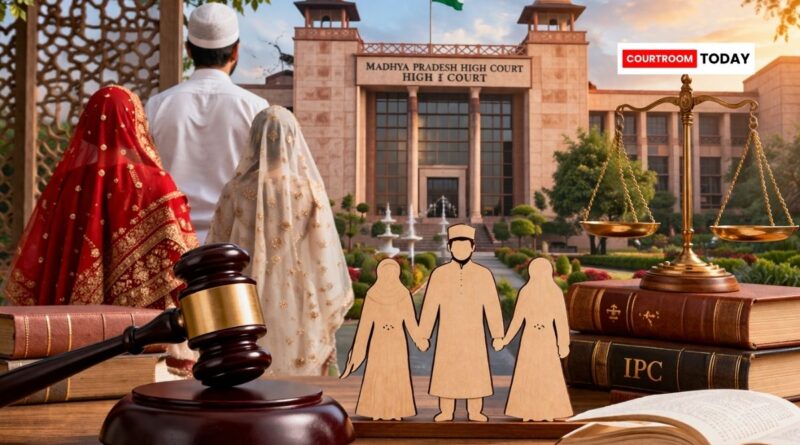
MP High Court: Polygamy Permitted Under Muslim Law, Section 494 IPC Not Attracted
The case of Mohd. Arif Ahmad Jahagir Khan vs The State Of Madhya Pradesh recently came before the Madhya Pradesh High Court, where the Court examined whether a Muslim man’s second marriage during the subsistence of his first marriage amounts to bigamy under Section 494 of the Indian Penal Code.
The Court clarified that such a second marriage cannot be treated as an offence of bigamy, as Muslim Personal Law permits polygamy. This distinction became central to the Court’s reasoning while partially allowing the petition filed by the husband.
A bench of Justice BP Sharma observed that Section 494 IPC applies only when the second marriage is void because the first marriage is still valid. However, under Muslim Personal Law, a man is permitted to have more than one wife, and therefore, the second marriage does not become void.
The Court clearly stated, “…the applicability of Section 494 IPC depends upon whether the second marriage is void by reason of the subsistence of the first marriage. In the present case, the parties are admittedly governed by Muslim Personal Law, which recognizes the permissibility of plurality of marriages.”
The case arose from a complaint filed by the petitioner’s first wife. She alleged that after their marriage in 2002, she faced cruelty due to her inability to bear a child. She further claimed that her husband contracted a second marriage in 2022 and pressured her to seek ‘Khula’, or mutual divorce.
Before the High Court, the husband argued that he could not be prosecuted for bigamy as Muslim Personal Law allows a man to have up to four wives. He relied on earlier judicial precedents, including the Kerala High Court’s decision in Venugopal vs. Union of India.
On the other hand, the complainant contended that the benefit of Muslim Personal Law should not apply automatically without proper declaration under the Muslim Personal Law (Shariat) Application Act, 1937.
The Court considered these arguments and referred to Supreme Court rulings in Sarla Mudgal vs. Union of India and Khursheed Ahmad Khan vs. State of UP. It reaffirmed that Muslim Personal Law recognises polygamy, and therefore, the essential ingredient of Section 494 IPC—voidness of the second marriage—was not satisfied.
The bench emphasised that continuing prosecution under Section 494 IPC in such circumstances would amount to an abuse of the legal process. Accordingly, the bigamy charge against the petitioner was quashed.
However, the Court made it clear that this relief was limited. The trial will continue for other offences alleged against the petitioner, including cruelty, wrongful confinement, assault, and criminal intimidation under Sections 498-A, 342, 323, and 506 Part-II IPC.
The trial court has been directed to independently assess these remaining charges based on evidence and proceed in accordance with the law.
——————————————–
Have a case update, article, or deal to share? Courtroom Today welcomes contributions from lawyers, law firms, and legal professionals. Write to contact@courtroomtoday.com