NLU Student Refuses to Remove Blog Criticising Supreme Court, Sparks Free Speech Debate
A recent controversy involving a National Law University (NLU) has raised concerns over academic freedom after a student was allegedly asked to remove a blog post criticising the Supreme Court’s stance on an NCERT textbook issue.
The incident centres around a law student from Tamil Nadu National Law University who authored a Substack article criticising the judiciary’s approach to removing certain content from a Class 8 NCERT textbook. The post reportedly questioned the tone and reasoning adopted by the Court.
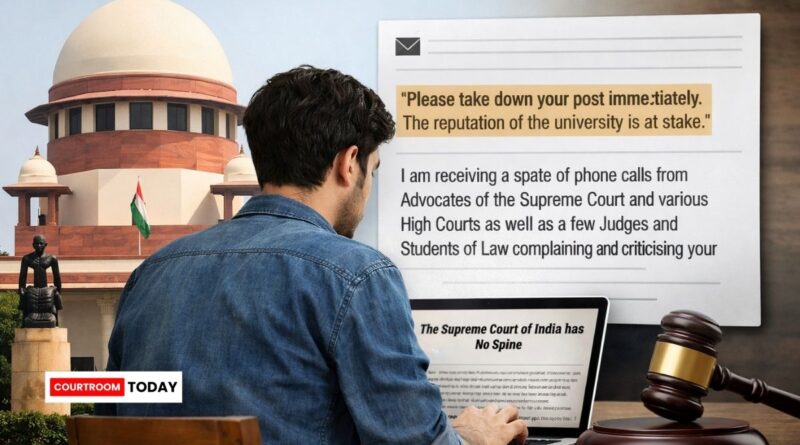
According to details that surfaced, the university administration reached out to the student through an email, expressing concern over the potential reputational impact of the article. The email stated, “I am receiving a spate of phone calls from Advocates of the Supreme Court and various High Courts as well as a few Judges and Students of Law, complaining and criticising your article posted in LinkedIn.”
The administration further urged the student to withdraw the content, adding that the institution’s reputation was at stake. It requested that the article be taken down “in the best interest of the university and yourself.”
However, the student refused to comply with the request and strongly defended his right to express personal opinions. In his response, he clearly stated, “My opinions are mine alone. Any attempt to conflate them with that of the university is clearly wrong.”
He further emphasised the autonomy of individual expression by stating, “It should be clear that the university has absolutely no jurisdiction over my personal expression. You do not own my voice or my conscience.”
The article in question reportedly criticised the conduct of the legal fraternity and the language used by the judiciary in relation to the removal of specific paragraphs in an NCERT chapter. These paragraphs were related to the issue of “Corruption in the Judiciary,” which ultimately led to the chapter being withdrawn.
Following his reply, the student claimed that there was no further communication from the university authorities. This has led to wider discussions within legal and academic circles regarding the limits of institutional control over students’ personal expression, especially when such expression relates to public issues.
The episode has also sparked debate on whether educational institutions should intervene in students’ opinions expressed on independent platforms, and how such actions may impact freedom of speech within academic environments.
The matter continues to draw attention, particularly among law students and educators, as it touches upon broader questions of constitutional values, academic independence, and the role of universities in regulating dissent.
——————————————–
Have a case update, article, or deal to share? Courtroom Today welcomes contributions from lawyers, law firms, and legal professionals. Write to contact@courtroomtoday.com