
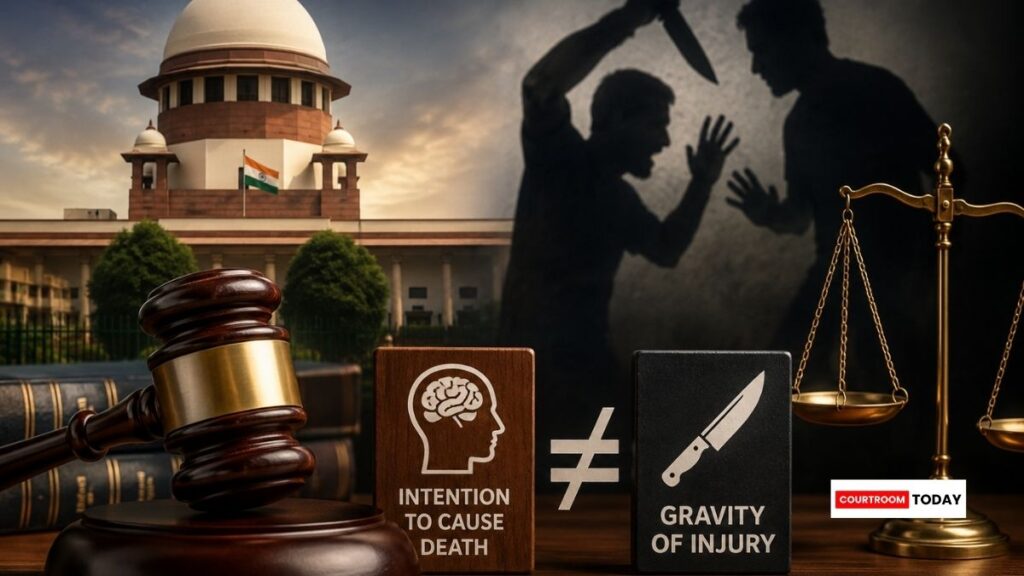
In Roshan Lal v. State of Haryana & Anr., the Supreme Court has ruled that the seriousness of an injury alone is not enough to convict a person for attempt to murder under Section 307 IPC. The Court said the prosecution must clearly prove the intention or knowledge to cause death before such a conviction can stand.
A Bench of Justice Sanjay Karol and Justice Nongmeikapam Kotiswar Singh set aside the conviction of the appellant after finding that the lower courts had relied mainly on the “dangerous to life” nature of the injury while ignoring the absence of any intention to kill.
The Court explained that Section 307 IPC requires two essential elements. First, there must be intention or knowledge to commit murder. Second, there must be an act towards carrying out that intention. Without proof of mens rea, the offence of attempt to murder cannot be established.
The Bench observed that intention cannot be presumed merely because the victim suffered a serious injury. The Court noted that there was no evidence of prior enmity, planning, repeated attacks, or conduct showing a determined effort to cause death.
“The intention to commit murder cannot be presumed merely because the injuries were ultimately opined to be dangerous to life,” the Court said while stressing that intention must be proved independently.
The case arose from an altercation where the injured person intervened in a dispute involving the appellant and another individual. According to the Court, the incident happened suddenly and appeared to be a spontaneous reaction during the heat of the moment rather than a planned attack.
The Bench further observed that the prosecution failed to show any prior motive or preparation by the accused to eliminate the injured person. In such circumstances, merely causing a dangerous injury would not automatically attract Section 307 IPC.
The judgment clarified that the essential ingredient of attempt to murder is the intention to cause death. The Court stated that once such intention is proved, the final result of the attack becomes less relevant unless death actually occurs. However, without proof of intention, conviction under Section 307 cannot survive.
Holding that the prosecution failed to establish the necessary mens rea, the Supreme Court allowed the appeal and acquitted the appellant.
——————————————–
Have a case update, article, or deal to share? Courtroom Today welcomes contributions from lawyers, law firms, and legal professionals. Write to contact@courtroomtoday.com