The Supreme Court of India has declined to issue fresh directions to curb hate speech, stating that the current legal framework is adequate. The ruling came while dismissing contempt petitions alleging non-compliance with its earlier 2023 directions.
The Bench of Justices Vikram Nath and Sandeep Mehta clarified that creating new criminal offences falls strictly within the domain of the legislature. Courts, it said, can interpret laws but cannot compel Parliament or state legislatures to enact new provisions.
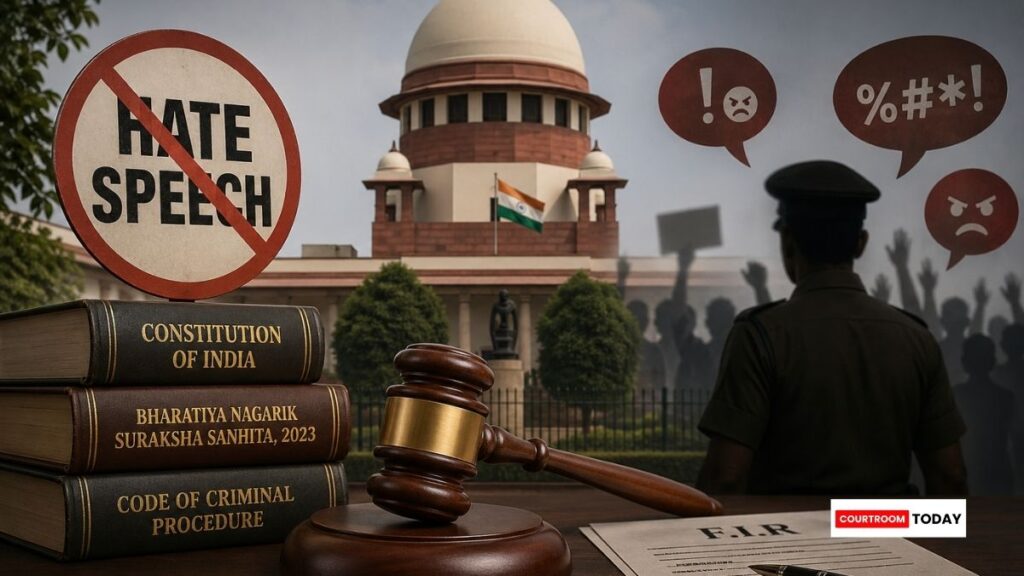
The Court emphasised that the issue is not the absence of law but its effective implementation. It noted that existing statutory mechanisms under the Code of Criminal Procedure and the Bharatiya Nagarik Suraksha Sanhita, 2023 already provide sufficient remedies.
Referring to established principles, the Court reiterated that police authorities are duty-bound to register FIRs when a cognisable offence is disclosed. It relied on the precedent laid down in Lalita Kumari, which makes FIR registration mandatory in such cases.
The judgement outlined remedies available to aggrieved persons in case of police inaction. These include approaching the Superintendent of Police, seeking directions from a magistrate under Section 156(3) CrPC (now Section 175(3) BNSS), or filing a private complaint.
The Bench also clarified that directing an investigation under Section 156(3) does not amount to taking cognisance. This distinction is important as prior sanction requirements apply only at the stage of cognisance, not during investigation.
While declining additional directions, the Court acknowledged the seriousness of hate speech. It observed that such issues directly affect fraternity, dignity, and the constitutional order, making them a matter of public concern.
At the same time, the Court urged legislative authorities to consider whether further reforms are needed. It referred to the Law Commission’s 267th Report and suggested that evolving social challenges may require policy review.
The case originates from multiple petitions filed since 2020 concerning alleged hate speech in media and public platforms. These included controversies such as the “Corona Jihad” narrative and the “UPSC Jihad” broadcast, which had earlier led to interim restrictions.
Subsequent petitions also raised concerns over speeches made at religious gatherings, including events described as “Dharam Sansad.” Petitioners had sought stronger legal measures to address such incidents.
In 2023, the Court had directed States and Union Territories to act proactively by registering FIRs even without formal complaints in hate speech cases. The present contempt petitions claimed that these directions were not being properly followed.
However, the Court concluded that the solution lies in enforcing existing laws rather than creating new ones, reinforcing the principle of separation of powers between the judiciary and legislature.
——————————————–
Have a case update, article, or deal to share? Courtroom Today welcomes contributions from lawyers, law firms, and legal professionals. Write to contact@courtroomtoday.com