No Posts for Men? MP High Court Examines 100% Women Reservation in Nursing College Teaching Posts
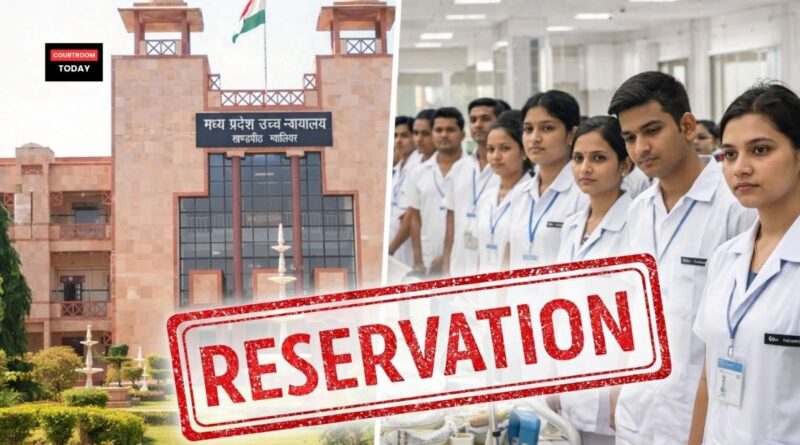
A decision by the Madhya Pradesh government to reserve 100 per cent teaching posts for women in government nursing colleges has come under legal scrutiny before the Madhya Pradesh High Court. The court is examining whether such a complete gender-based reservation is constitutional.
The case relates to a recruitment notification issued by the Madhya Pradesh Staff Selection Board for the Group-1, Sub-Group-2 Combined Recruitment Examination 2025. Under this notification, all 286 teaching posts in government nursing colleges were reserved only for women, leaving no opportunity for male candidates to apply.
The vacancies include 40 Associate Professor posts, 28 Assistant Professor posts, and 218 Sister Tutor posts. Since none of these positions were kept open for men, the recruitment drive was challenged before the Jabalpur Bench of the High Court.
The petition has been filed by Naushad Ali and other applicants from Jabalpur, who argue that the recruitment process violates the fundamental rights guaranteed under Articles 14, 15 and 16 of the Constitution. These articles ensure equality before law, prohibit discrimination on the basis of sex, and guarantee equal opportunity in public employment.
Appearing for the petitioners, Advocate Vishal Baghel submitted that neither the recruitment rules nor the guidelines of the Indian Nursing Council permit a complete exclusion of men from teaching posts in nursing colleges. While limited or reasonable reservation may be allowed, he argued that a blanket ban on one gender is legally impermissible.
The petitioners also relied on the Indra Sawhney judgment of the Supreme Court, which laid down that reservation in public employment should ordinarily not exceed 50 per cent. On this basis, they contended that a 100 per cent reservation policy is against settled constitutional principles and cannot be sustained in law.
During the hearing held on December 29, the High Court sought a response from the Madhya Pradesh government and noted that the last date to apply for the posts was January 7. The petitioners pointed out that if immediate relief was not granted, male candidates would permanently lose their chance to apply, making the legal challenge ineffective.
Taking these concerns into account, the court directed the State government to place its decision on record within one day and listed the matter for further hearing on January 7.
Interestingly, during the proceedings, the Madhya Pradesh Staff Selection Board informed the court that a decision had already been taken to include male candidates in the recruitment process. The Board stated that its final position would be clearly presented before the court on the next date of hearing.
The case is being heard by Justice Vishal Dhagat at the Principal Bench of the Madhya Pradesh High Court.
This dispute has arisen at a time when serious concerns have already been raised about the quality and regulation of nursing colleges in Madhya Pradesh. Earlier reports had highlighted irregularities such as lack of proper infrastructure, shortage of qualified faculty, and even colleges functioning only on paper.
The final outcome of this case is expected to have a wider impact on gender-based reservation policies, public employment norms, and governance of nursing education in the state.
——————————————–
Have a case update, article, or deal to share? Courtroom Today welcomes contributions from lawyers, law firms, and legal professionals. Write to contact@courtroomtoday.com