
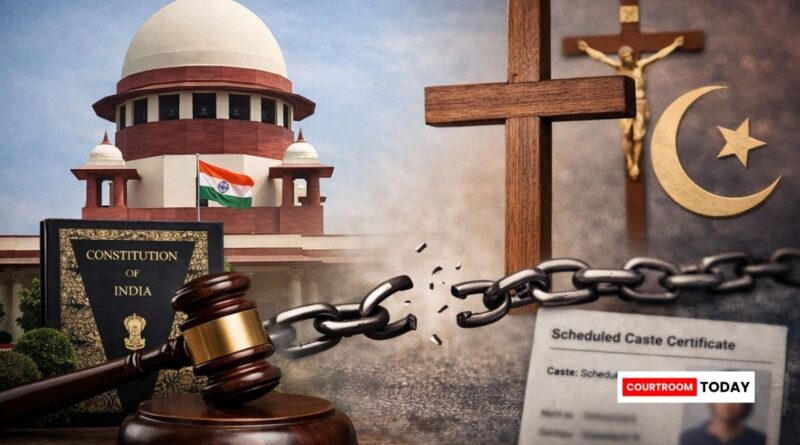
No Scheduled Caste Benefits After Conversion Outside Hinduism, Sikhism, Buddhism, Says Supreme Court
In Chinthada Anand v State of Andhra Pradesh and Ors. (SLP (Crl) No. 9231/2025), The Supreme Court has reaffirmed that conversion to a religion other than Hinduism, Buddhism or Sikhism results in the complete loss of Scheduled Caste (SC) status under Indian law.
The Court upheld the Andhra Pradesh High Court’s decision, holding that a person who converts to Christianity and continues to practice the faith cannot be treated as a member of a Scheduled Caste. As a result, such a person cannot claim protection under the Scheduled Castes and Scheduled Tribes (Prevention of Atrocities) Act.
The Bench comprising Justice Prashant Kumar Mishra and Justice Manmohan emphasised that the position is clearly governed by the Constitution (Scheduled Castes) Order, 1950. Under Clause 3 of this Order, only persons professing Hinduism, Sikhism or Buddhism can be recognised as members of the Scheduled Castes.
The Court made it clear that this restriction is absolute. It observed, “No statutory benefit, protection or reservation or entitlement under the Constitution or enactment of Parliament or state legislature can be claimed… This bar is absolute and admits no exception.”
The case arose from a complaint filed by a pastor who alleged assault and caste-based abuse, invoking provisions of the SC/ST Act. However, the accused challenged the applicability of the law, arguing that the complainant had converted to Christianity and was no longer entitled to SC status.
The Supreme Court examined the facts and noted that the complainant had been actively practising Christianity for several years and was functioning as a pastor, regularly conducting prayer meetings. The Court found no evidence of reconversion or re-acceptance into his original caste community.
Importantly, the Court held that even if a caste certificate continues to exist, it does not automatically entitle a person to claim SC benefits after conversion. Such certificates must be examined under the relevant statutory framework, but their mere existence cannot override constitutional provisions.
The judgment reinforces a strict interpretation of the 1950 Order, clarifying that religious identity plays a decisive role in determining eligibility for Scheduled Caste status. It also reiterates that legal protections under the SC/ST Act are contingent upon valid recognition as a member of a Scheduled Caste at the time of the alleged offence.
This ruling is likely to have significant implications for cases involving conversion and caste-based protections, particularly in determining the applicability of welfare measures and criminal law safeguards.
——————————————–
Have a case update, article, or deal to share? Courtroom Today welcomes contributions from lawyers, law firms, and legal professionals. Write to contact@courtroomtoday.com