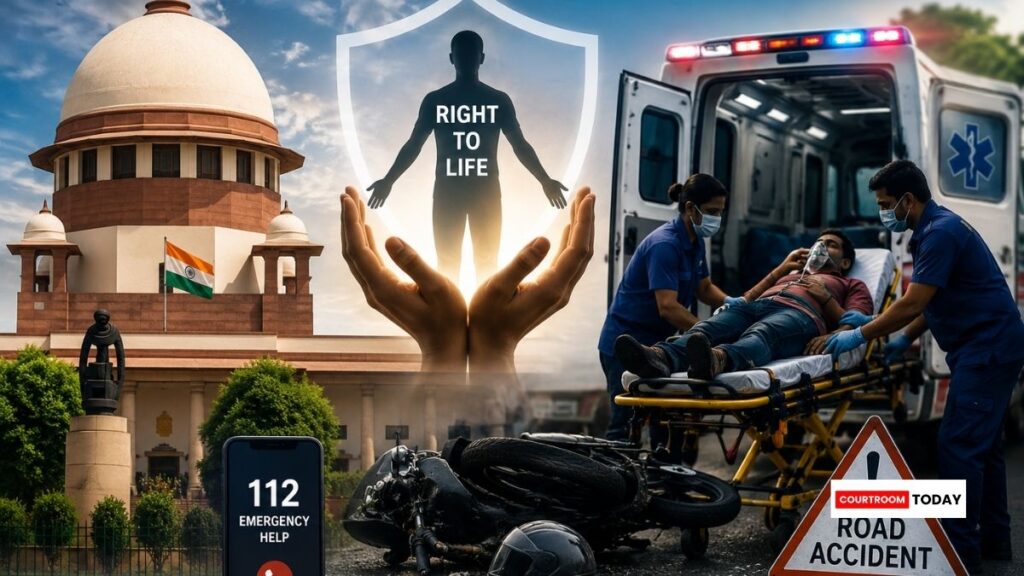
In Savelife Foundation vs. Union of India, the Supreme Court has declared that access to trauma care is a part of the fundamental right to life under Article 21 of the Constitution. The Court also issued nationwide directions to create a uniform and effective trauma response system for road accident victims.
A Bench of Justices JK Maheshwari and Atul S Chandurkar observed that timely medical intervention can make the difference between life and death in accident cases. The Court noted that accident victims often experience shock, helplessness, and confusion while waiting for urgent care.
The judgement stated, “When a person suffers an accident or any such similar incident which requires urgent trauma care, they usually feel shock and disorientation, a sense of helplessness, where they have to hope that those around them would somehow help them get the care that they need.”
The Bench further added, “In such a situation, every minute spent without medical intervention or urgent care significantly narrows the scope for survival. Swiftness, is quite literally, like medicine.”
The case was filed by SaveLIFE Foundation seeking directions for improving emergency medical systems across the country. The petition highlighted gaps in ambulance services, trauma care protocols, emergency helplines, and implementation of road accident victim schemes.
The Court acknowledged that the Union government had introduced several initiatives, including PM RAHAT, the Rah-Veer Scheme, Good Samaritan Rules, the National Ambulance Code, and ERSS-112. However, it observed that implementation at the State level remained fragmented and insufficient.
To address these issues, the Court issued nine major directions to all States and Union Territories. It ordered the integration of emergency helplines such as 100, 101, 102, 1033, 108, and 1091 into the unified 112 helpline within three months.
The Court also directed States to establish Good Samaritan grievance redressal systems with nodal officers at district and State levels. Monthly review meetings and public compliance reporting were also made mandatory.
Further, the Ministries of Health and Road Transport were instructed to frame a standardised trauma rescue protocol within three months. States and UTs must implement the protocol within the following three months.
The Court ordered mandatory GPS tracking and compliance audits for ambulances, adoption of standard EMT training curriculum for paramedics, and creation of State Trauma Registries connected to a national database.
The Bench also directed States to operationalise the Cashless Treatment of Road Accident Victims Scheme, 2025, within three months. It warned that failure to implement PM RAHAT requirements would amount to violation of the Motor Vehicles Act, 1988.
The Supreme Court has now asked all Chief Secretaries to submit action-taken reports before the next hearing scheduled after four months.
——————————————–
Have a case update, article, or deal to share? Courtroom Today welcomes contributions from lawyers, law firms, and legal professionals. Write to contact@courtroomtoday.com