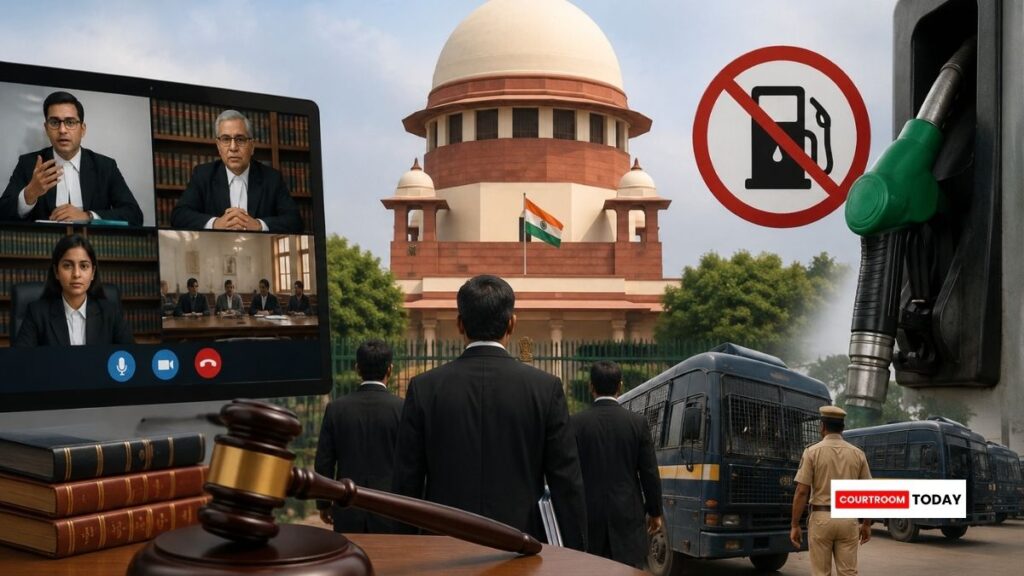
In Shobha Gupta vs Union of India, the Supreme Court on Tuesday declined to issue directions compelling advocates to attend court proceedings only through virtual mode amid the ongoing fuel crisis linked to the conflict in West Asia.
A bench comprising Surya Kant, Joymalya Bagchi and Vipul M. Pancholi observed that while the Court could encourage virtual appearances, it could not judicially mandate lawyers to attend hearings online without considering practical difficulties faced by members of the Bar.
The matter arose from a writ petition seeking directions for virtual hearings of miscellaneous matters for three months in view of the fuel shortage situation. The petitioner argued that large amounts of fuel are consumed daily by advocates travelling to courts and by transportation of prisoners for physical production before courts.
The bench appreciated the petitioner’s initiative but clarified that such a direction could not be imposed through judicial orders. The Court stated that it would instead make an earnest appeal through its administrative side asking lawyers to participate in proceedings virtually wherever possible.
The bench observed, “We appreciate the initiative taken by the petitioner. However, it may not be prudent to issue judicial command for members to appear online without knowing the difficulties faced by them.”
During the hearing, the Chief Justice clarified that the Supreme Court had already issued an administrative circular encouraging virtual appearances. However, he stressed that such measures could not become compulsory.
“It is not the Court’s command. We have only issued an administrative circular requesting members of the Bar to join proceedings from home through virtual mode. But we cannot impose such restrictions,” the CJI remarked in open court.
The petitioner also raised concerns regarding fuel consumption caused by transporting prisoners to courts. It was submitted that more than 250 buses are used daily for ferrying prisoners for court appearances and that virtual production could significantly reduce fuel use.
Responding to this submission, the Chief Justice noted that the Punjab and Haryana High Court already allows prisoners to appear through video conferencing. He added that if any High Court was not following a similar system, the issue could be examined administratively after collecting relevant information.
The Court was also informed that the Supreme Court had recently introduced administrative measures for virtual hearings on miscellaneous days and partial working days in line with the Union government’s fuel conservation efforts. However, after objections and representations from members of the Bar, the Court later clarified that physical appearances would continue for advocates facing unavoidable difficulties in attending virtually.
The writ petition was ultimately disposed of without issuing any binding directions.
——————————————–
Have a case update, article, or deal to share? Courtroom Today welcomes contributions from lawyers, law firms, and legal professionals. Write to contact@courtroomtoday.com