
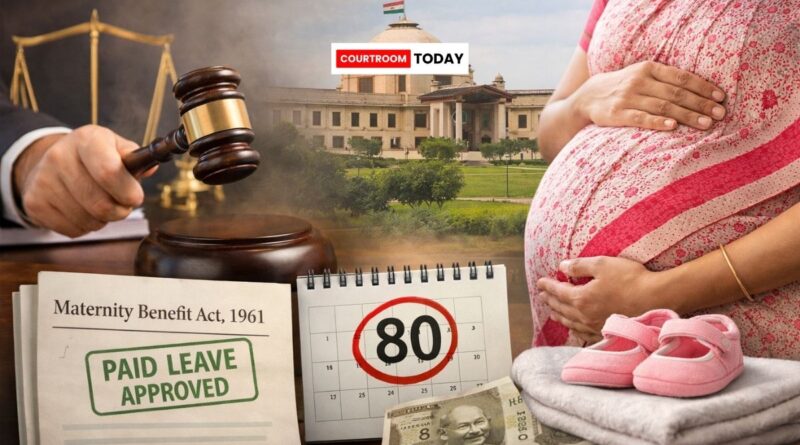
State Must Ensure Maternity Benefits, 80-Day Work Rule Not Applicable: MP High Court
The Madhya Pradesh High Court, in Dr Priti Saket v State of Madhya Pradesh [WP-9877-2026], has ruled that the State cannot deny paid maternity leave by relying on the 80-day work requirement under the Maternity Benefit Act, 1961.
The decision was delivered by Justice Vishal Dhagat, who clarified that the restriction under Section 5(2) of the Act does not apply to State Government establishments. The Court stressed that the State has a constitutional duty to ensure welfare measures for women employees.
The Court observed, “Section 5(2) of the Act of 1961, bars benefit of maternity leave unless woman has worked for 80 days in 12 months. Said bar of working 80 days in 12 months for availing benefit of grant of maternity leave shall not be applicable over establishment of State Government. State is required to take welfare measures for its citizens”.
The case arose from a petition filed by a guest faculty member who was denied honorarium during her maternity leave. Although she was granted leave for six months, the benefit of payment was refused on the ground that she had not completed 80 days of work in the preceding year.
The petitioner also alleged harassment and discrimination, stating that she was being targeted due to her belonging to a Scheduled Caste category. However, the Court focused primarily on the legal issue concerning the applicability of the Maternity Benefit Act.
The bench noted that the petitioner was working on a contractual basis and therefore was not covered under the Madhya Pradesh Civil Services Leave Rules. Despite this, the Court examined whether the Maternity Benefit Act applied to her employment.
Referring to Section 2(1) of the Act, the Court highlighted that the legislation has a broad scope. It applies not only to private establishments but also to government institutions and workplaces employing ten or more individuals.
The Court further acknowledged that ordinarily, the Act requires a woman to have worked for at least 80 days in the preceding 12 months to claim maternity benefits. However, it emphasised that this condition cannot override constitutional principles when the employer is the State.
Relying on the spirit of the Constitution, the Court pointed out that the State must promote welfare and protect the health and dignity of women workers. It held that denying maternity benefits on technical grounds would defeat these objectives.
Accordingly, the Court set aside the impugned order and directed that the petitioner be granted the full benefit of maternity leave, including payment.
——————————————–
Have a case update, article, or deal to share? Courtroom Today welcomes contributions from lawyers, law firms, and legal professionals. Write to contact@courtroomtoday.com