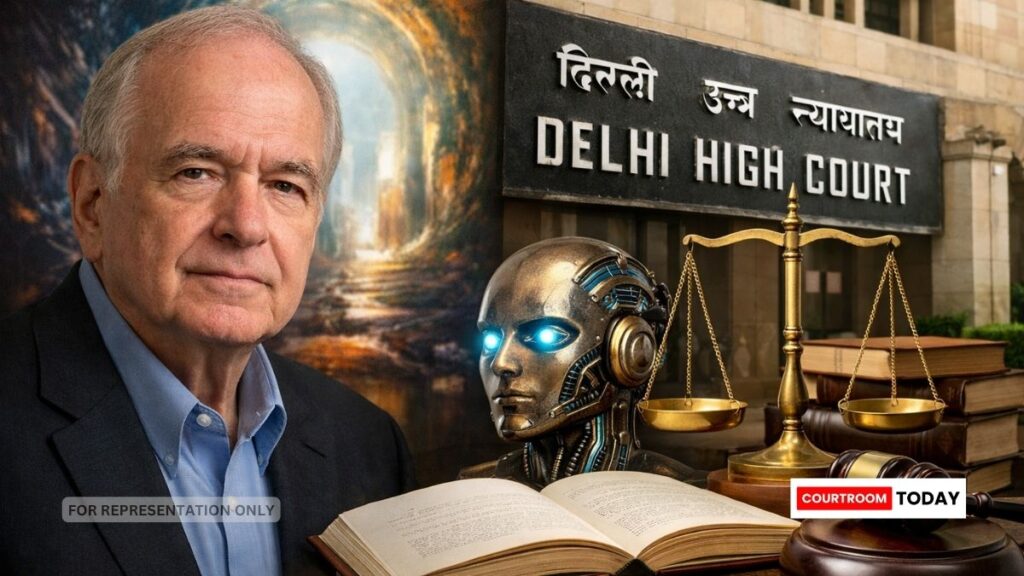
The Delhi High Court in Stephen Thaler v. Union of India has directed the Copyright Office to decide, within eight weeks, a long-pending application seeking copyright registration for an artwork created by artificial intelligence.
The matter concerns an artwork titled A Recent Entrance to Paradise, which is claimed to have been generated autonomously by an AI system known as DABUS (Device for the Autonomous Bootstrapping of Unified Sentience). The petitioner, Stephen Thaler, is an American AI researcher.
Justice Tushar Rao Gedela disposed of the plea after noting that a hearing has already been scheduled by the Copyright Office on April 27, 2026. The Court directed the Registrar of Copyrights to conclude proceedings expeditiously within eight weeks from that date.
Thaler had filed the copyright application in 2022. However, the application remained undecided for nearly four years. The plea before the High Court sought a direction to ensure that the application is processed and decided in accordance with law.
The core issue in the case relates to authorship under the Copyright Act, 1957. The law recognises “computer-generated works” but does not clearly address whether a non-human entity, such as an AI system, can be considered an author.
During examination of the application, objections were raised on the ground that only a natural person can qualify as an author. This position reflects the traditional understanding of authorship under Indian copyright law.
Thaler has argued that AI-generated works fall within the scope of “computer-generated works”. According to this argument, authorship could vest in the person who causes the work to be created, even if the creative process is carried out autonomously by an AI system.
The case highlights a growing challenge within intellectual property law. As generative AI technologies evolve, questions regarding ownership, authorship, and rights over machine-generated content are becoming increasingly significant.
Globally, similar attempts by Thaler have faced rejection. Courts and authorities in jurisdictions such as the United States, United Kingdom, and European Union have consistently held that only natural persons can be recognised as authors or inventors under existing legal frameworks.
Despite this trend, the present case marks one of the first instances in India where the issue of copyright protection for AI-generated works is directly raised before the judiciary.
The outcome of this case could have far-reaching implications. It may influence how Indian law interprets authorship and ownership in the context of artificial intelligence, particularly as AI-generated content becomes more common across industries.
The decision may also contribute to ongoing discussions on whether intellectual property laws need to be updated to accommodate technological advancements.
Stephen Thaler was represented by Advocates Ankit Sahni, Kritika Sahni, Chirag Ahluwalia and Aman Sinha in the proceedings.
——————————————–
Have a case update, article, or deal to share? Courtroom Today welcomes contributions from lawyers, law firms, and legal professionals. Write to contact@courtroomtoday.com