
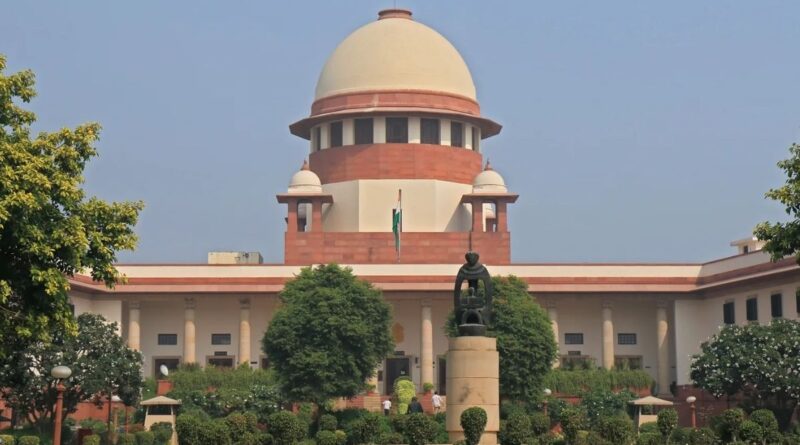
Supreme Court Allows Judicial Officers with 7 Years’ Bar Experience to Apply for District Judge Posts
The Supreme Court has ruled that judicial officers who had at least seven years of experience as practising lawyers before joining the judicial service are eligible to be appointed as District Judges through direct recruitment under the Bar quota.
A Constitution Bench led by Chief Justice of India BR Gavai, along with Justices MM Sundresh, Aravind Kumar, Satish Chandra Sharma and K Vinod Chandran, delivered this important judgment in Rejanish KV v. K Deepa & Ors on Thursday.
The Court observed that denying judicial officers the opportunity to compete for these posts had resulted in injustice. It overturned the 2020 decision in Dheeraj Mor, where the Court had barred judicial officers from applying under the Bar quota.
However, the latest ruling will apply only to future recruitment processes, except where interim orders by High Courts or the Supreme Court are already in place.
The bench stated, “Judicial officers who had completed seven years of practice at the Bar before joining the judicial service will be eligible for appointment as District Judges or Additional District Judges through direct recruitment.”
The Court directed State governments, in consultation with their respective High Courts, to frame fresh rules for such recruitment. It further ordered that all existing rules inconsistent with the new interpretation shall stand invalid.
The Court clarified that eligibility will be assessed at the time of application. It also recognised that a combined experience of seven years as an advocate and a judicial officer would make a candidate eligible for the post.
“The minimum age for both advocates and judicial officers applying through this route shall be 35 years on the date of application,” the Court said.
It further clarified that only those with continuous experience — either as an advocate, government pleader, public prosecutor, judicial officer, or a combination of these — will be eligible for direct recruitment.
The Court noted that judicial officers undergo rigorous training and gain deeper legal experience, often surpassing that of advocates. Therefore, it found no justification for excluding them from competing with members of the Bar.
Highlighting the inconsistency in previous interpretations, the Bench observed, “If government pleaders and public prosecutors who practice in court are eligible to apply, it is unreasonable to disqualify judicial officers before whom these very lawyers appear.”
The judges said that expanding the pool of eligible candidates would enhance efficiency in the district judiciary and promote merit-based appointments.
Addressing concerns about seniority or resentment, the Court said that all candidates—advocates and judicial officers alike—must compete on merit, leaving no room for grievances.
Justice MM Sundresh, in a separate but concurring opinion, discussed the scope of Article 233 of the Constitution and the principle of separation of powers. He noted that the Constitution gives primacy to High Courts in appointing District Judges, reinforcing the judiciary’s independence.
Justice Sundresh further stated that limiting Article 233(2) only to advocates and pleaders would violate the equality guaranteed under Article 14 of the Constitution.
——————————————–
Have a case update, article, or deal to share? Courtroom Today welcomes contributions from lawyers, law firms, and legal professionals. Write to contact@courtroomtoday.com