Supreme Court Allows Withdrawal of Life Support in First Passive Euthanasia Order
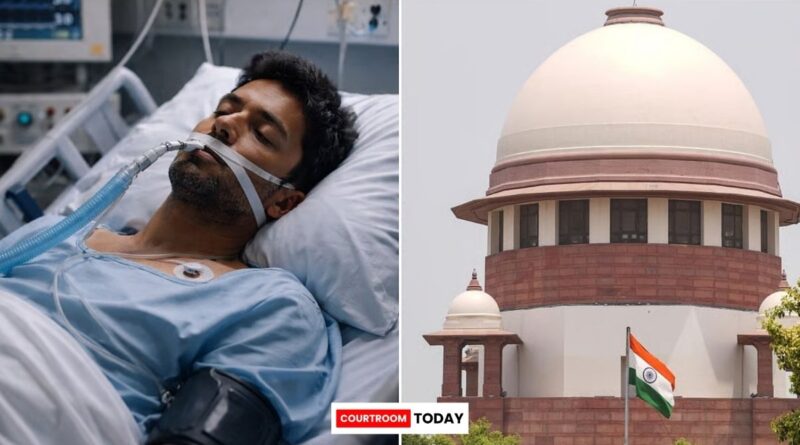
In a significant development, the Supreme Court of India has allowed the withdrawal of life support for a man who had been in a permanent vegetative state for more than thirteen years, marking the first judicial application of the guidelines on passive euthanasia laid down in the 2018 Common Cause judgement.
The order was passed in Harish Rana vs Union of India, where a bench comprising Justice JB Pardiwala and Justice KV Viswanathan permitted the removal of life-sustaining treatment for Harish Rana, a 32-year-old man who suffered severe brain injuries after falling from the fourth floor of his paying guest accommodation many years ago. Since the accident, he had remained in an irreversible persistent vegetative state with complete quadriplegia.
The Court noted that medical records showed no improvement in his condition for over a decade. Rana was surviving only through Clinically Administered Nutrition (CAN), which was being supplied through surgically inserted PEG tubes. The bench observed that continuing such treatment merely prolonged biological existence without offering any possibility of recovery.
Importantly, both the Primary Medical Board and the Secondary Medical Board had unanimously recommended the withdrawal of life support. The Court held that CAN qualifies as medical treatment and can therefore be discontinued when medical boards determine that continuing it is not in the patient’s best interest.
While the Supreme Court observed that judicial intervention is generally unnecessary when both medical boards approve withdrawal of life support, the matter was considered by the Court because this was the first case under the Common Cause framework to reach this stage.
Accordingly, the Court directed that all medical treatment, including the clinically administered nutrition, be withdrawn. The usual reconsideration period of thirty days was waived in this case.
The Court also instructed the All India Institute of Medical Sciences (AIIMS) to admit the patient to its palliative care centre so that the withdrawal of life support can be carried out in a medically supervised and dignified manner. AIIMS was further directed to facilitate the patient’s transfer from his residence to the palliative care facility.
Emphasising dignity in the process, the bench directed that life support should be withdrawn under a carefully tailored plan ensuring humane and respectful treatment.
The Court also issued broader administrative directions. High Courts across the country were asked to instruct Judicial Magistrates to receive hospital intimations whenever medical boards unanimously decide to withdraw or withhold life support in accordance with the Common Cause guidelines. The Union government was also directed to ensure that Chief Medical Officers in all districts maintain panels of registered medical practitioners who can serve on secondary medical boards.
Justice Pardiwala, who authored the main judgement, also expressed appreciation for the dedication shown by the patient’s parents. Reflecting on their years of care, the judge observed: “His family never left his side…to love someone is to care for them even in the darkest times.”
The Court further recommended that the Union government enact comprehensive legislation governing passive euthanasia to provide clearer legal and procedural guidance in such cases.
The matter had earlier been brought before the Delhi High Court in 2024, where the petition was dismissed on the ground that the patient was not terminally ill. The Supreme Court had initially declined to entertain the plea but later examined the case again after medical reports confirmed that recovery was virtually impossible.
With this ruling, the Supreme Court has effectively operationalised its earlier recognition of the right to die with dignity under Article 21 of the Constitution.
——————————————–
Have a case update, article, or deal to share? Courtroom Today welcomes contributions from lawyers, law firms, and legal professionals. Write to contact@courtroomtoday.com