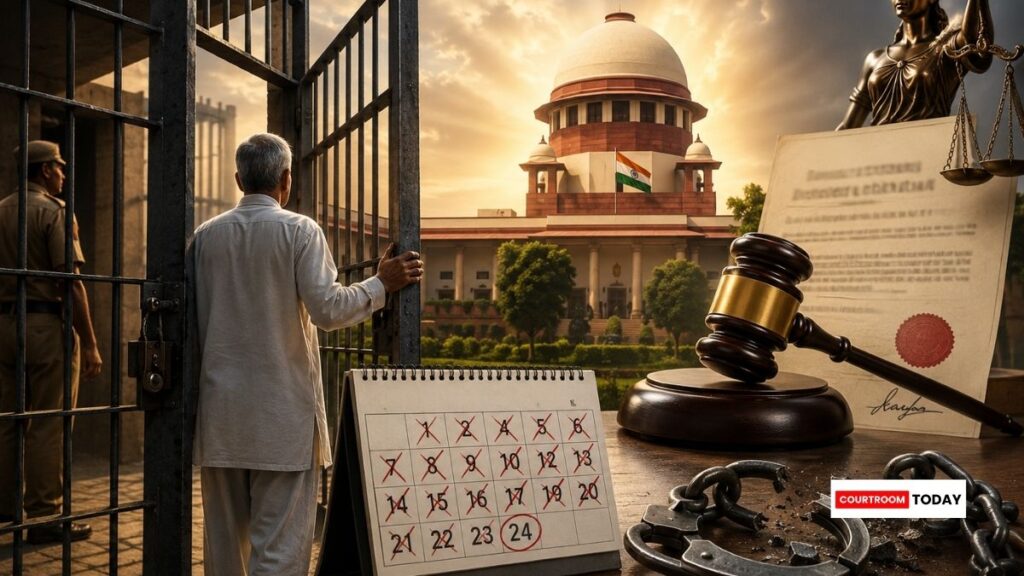
In Daudayal v. State of Rajasthan, the Supreme Court has awarded ₹11 lakh compensation to a convict who remained in prison for 24 days despite a Rajasthan High Court order directing his release on parole. The Court held that personal liberty cannot be curtailed merely because authorities are considering whether to challenge a judicial order.
A Bench comprising Justice Sanjay Karol and Justice AG Masih observed that once a court directs a person’s release, the order must be implemented without delay unless it is stayed by a superior court. The judges stressed that the rights of a convicted individual do not disappear simply because the person is serving a sentence.
The case concerned Daudayal, who was convicted in connection with a 1967 incident involving allegations of unlawful assembly, house trespass, and culpable homicide not amounting to murder. Although the trial court had sentenced him in 1988, the Rajasthan High Court upheld the conviction and sentence in 2021, after which he was taken into custody.
While serving his sentence, Daudayal applied for permanent parole in 2023. His request was rejected by prison authorities, prompting him to approach the Rajasthan High Court. On November 5, 2024, a Single Judge of the High Court ordered his release on parole subject to certain conditions.
Daudayal complied with the conditions and his sureties were verified on November 13, 2024. However, despite fulfilling all requirements, he continued to remain in prison. He later approached a Division Bench of the High Court, which directed his immediate release on December 6, 2024.
Before the Supreme Court, Daudayal argued that there was no legal basis for keeping him in custody after the parole conditions had been satisfied. He contended that the continued detention violated his fundamental right to personal liberty under Article 21 of the Constitution.
The State of Rajasthan defended the delay by claiming that officials were examining whether the High Court’s parole order should be challenged and that the order itself was contrary to applicable parole rules.
The Supreme Court rejected this justification. The Bench held that administrative deliberations regarding a possible appeal could not become a reason for ignoring a valid court order. The judges noted that once the conditions imposed by the High Court had been met and verified, there was no lawful ground to keep Daudayal behind bars.
“The liberty of an individual is not a trivial matter. The State cannot continue curtailing the same in the face of a court order, on account of its slow bureaucratic processes of taking decisions whether to file appeals in a particular matter or not,” the Court observed.
Holding that the additional 24 days spent in prison amounted to illegal detention, the Supreme Court allowed the appeal and directed the State of Rajasthan to pay ₹11 lakh as compensation for the violation of Daudayal’s personal liberty.
——————————————–
Have a case update, article, or deal to share? Courtroom Today welcomes contributions from lawyers, law firms, and legal professionals. Write to contact@courtroomtoday.com