
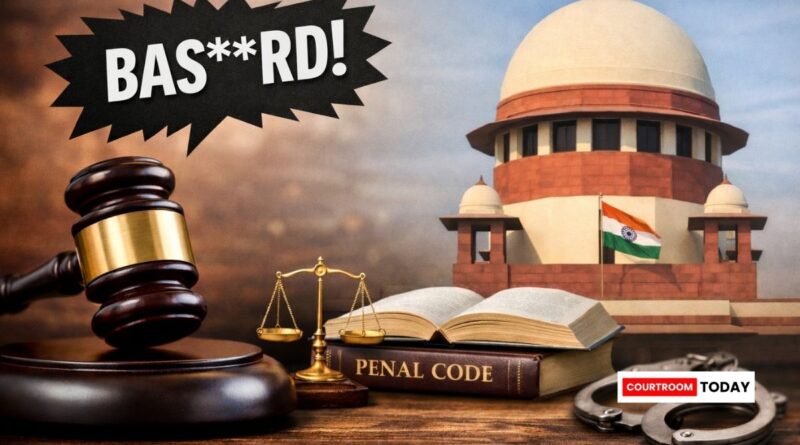
Supreme Court: Calling Someone “Bas**rd” Not Obscenity Under Section 294 IPC
In Sivakumar v. State Rep. by the Inspector of Police, the Supreme Court clarified that merely using abusive language such as “bastard” does not amount to obscenity under Section 294 of the Indian Penal Code. The ruling draws an important distinction between vulgarity and legally punishable obscenity.
The judgment was delivered by a bench comprising Justice PS Narasimha and Justice Manoj Misra. The Court was hearing an appeal against the conviction of two individuals accused of using the term “bastard” during a heated family dispute over property.
The Court set aside the conviction under Section 294(b) IPC. It held that the use of such language, in isolation, does not satisfy the legal threshold required to constitute an offence of obscenity. The judges emphasised that context and content must be carefully examined.
Importantly, the Court observed that the term “obscene” has not been explicitly defined in the penal law. Therefore, judicial interpretation becomes crucial in determining what qualifies as obscenity in a given case.
Referring to the earlier decision in Apoorva Arora & Anr. v. State (Govt. of NCT of Delhi) & Anr., the Court reiterated that obscenity involves material that triggers sexual or lustful thoughts. In contrast, general abusive language, even if offensive, does not necessarily carry such an element.
The bench noted, “…mere use of the word ‘bastard’, by itself, is not sufficient to arouse prurient interest of a person. More so, when such words are commonly used in modern era during heated conversations. We are, therefore, of the view that conviction of the appellants for offence punishable under Section 294(b) IPC is not sustainable and is hereby set aside.”
The Court further relied on established principles from the Apoorva Arora judgment, stating, “…vulgarity and profanities do not per se amount to obscenity. While a person may find vulgar and expletive-filled language to be distasteful, unpalatable, uncivil, and improper, that by itself is not sufficient to be “obscene”.”
This ruling highlights that not all offensive or abusive speech can be criminalised under Section 294 IPC. The presence of a sexual or prurient element remains a key requirement for invoking the offence of obscenity.
The judgement serves as a reminder that criminal law must not be applied broadly to penalise speech that, although undesirable, does not meet the statutory criteria. It reinforces the importance of interpreting penal provisions strictly and in line with established legal standards.
——————————————–
Have a case update, article, or deal to share? Courtroom Today welcomes contributions from lawyers, law firms, and legal professionals. Write to contact@courtroomtoday.com