
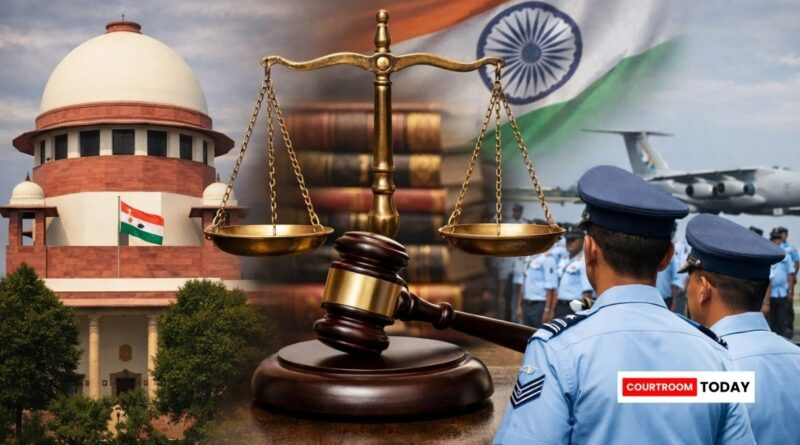
Supreme Court Declares Air Force Group Insurance Society a ‘State’ Under Article 12
In Ravi Khokhar & Ors vs Union of India & Ors, the Supreme Court has held that the Air Force Group Insurance Society (AFGIS) qualifies as a ‘State’ under Article 12 of the Constitution, making it subject to writ jurisdiction.
The decision was delivered by a bench comprising Justices Sanjay Karol and Vipul M Pancholi. The Court overturned the Delhi High Court’s earlier ruling, which had denied AFGIS the status of a State and dismissed the writ petitions filed by its employees.
The Court emphasised that AFGIS performs a public function closely connected with the welfare of Indian Air Force personnel. It observed, “We are of the considered view that AFGIS does indeed perform a public duty. The protection and welfare of armed forces personnel is a core government function.”
The bench further highlighted the nature of responsibilities discharged by armed forces personnel. It noted that their role is directly linked to national security, and therefore, ensuring their welfare through mechanisms like insurance is a collective obligation of the State.
The Court examined multiple factors to determine whether AFGIS falls within the ambit of Article 12. It pointed out that the Society was established with the sanction of the President of India and operates under rules approved at the highest level of government.
It also noted that AFGIS functions under close administrative and financial supervision. Regular reporting of financial activities to senior Air Force authorities reflects a high degree of governmental oversight in its functioning.
Significantly, the Court observed that both the Board of Trustees and the Managing Committee of AFGIS consist entirely of serving Air Force officers. These officers are deputed for fixed tenures, indicating that the organisation is effectively managed by government personnel.
Another important aspect considered was the compulsory nature of membership. The Court noted that Air Force personnel are mandatorily enrolled in the scheme, with deductions made as part of service conditions, leaving no individual choice in the matter.
The dispute arose from changes in employee pay structures. In 2016, AFGIS decided to align salaries with the Sixth Central Pay Commission. However, this decision was reversed in 2017, and employees were asked to accept revised service conditions.
Aggrieved employees approached the Delhi High Court under Article 226. The High Court dismissed their petitions, holding that AFGIS was a self-funded welfare body and not a State, thereby making writ petitions non-maintainable.
Setting aside this view, the Supreme Court clarified that determining whether an entity is a State depends on cumulative factors such as the nature of functions, degree of control, and extent of governmental involvement.
“The test to be satisfied pertained to the nature of functions, character of activity, degree of governmental control,” the Court stated, stressing that such evaluation must go beyond mere ownership and focus on accountability and governance.
Allowing the appeal, the Court directed the Delhi High Court to hear the writ petitions on merits. It also requested expeditious disposal, noting that the matter has been pending since 2017.
——————————————–
Have a case update, article, or deal to share? Courtroom Today welcomes contributions from lawyers, law firms, and legal professionals. Write to contact@courtroomtoday.com