Supreme Court Declines Year-Long Construction Ban Amid Delhi Pollution Crisis
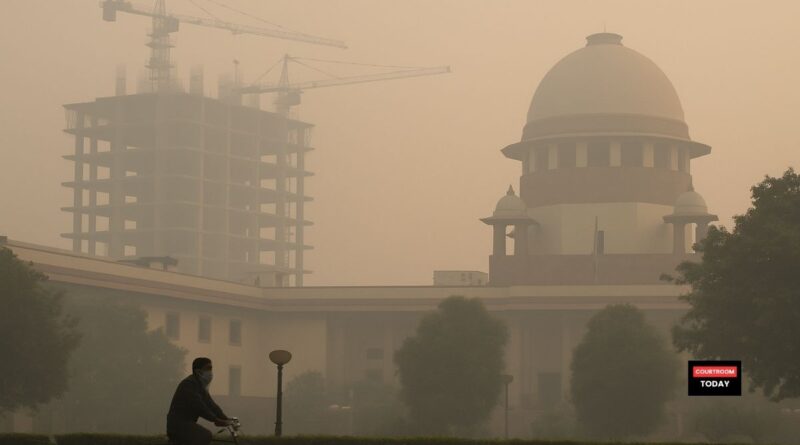
The Supreme Court, while hearing the ongoing Delhi–NCR air pollution case, said it was not willing to order extreme steps like a year-long ban on construction activities. The bench noted that such a sweeping direction could affect the livelihood of lakhs of workers and disrupt daily life across the region.
During the hearing, Senior Advocate Gopal Sankaranarayanan, appearing for a group of intervenors in the MC Mehta matter, described the current pollution situation as nothing less than an “emergency”. He warned that air quality levels had crossed dangerous limits and were causing long-term, irreversible harm, especially to children. He requested the Court to consider strict steps such as a complete stop on construction work and a ban on private vehicles. “We all have to sacrifice,” he submitted, pointing out reports that one in three deaths in the NCR are linked to air pollution and that lung cancer cases are sharply rising.
However, the bench led by Chief Justice of India BR Gavai, along with Justices K Vinod Chandran and NV Anjaria, firmly stated that it would not impose a total construction ban.
The CJI asked Additional Solicitor General Aishwarya Bhatti, representing the Union government, to consult with the Ministry of Environment & Forest and the Delhi Chief Secretary and present long-term measures. He stressed that the government should not suggest short-term steps of two days or one week, but instead come up with sustainable solutions so that pollution reduces gradually every year.
The CJI remarked that stopping all activities in Delhi was not possible, noting that such a move would even force courts to shut down. At this point, Sankarnarayanan suggested that courts could operate online temporarily.
The ASG reminded the Court that a complete ban on construction would severely affect daily wage workers who travel from neighbouring states such as Uttar Pradesh and Bihar. The CJI agreed that the issue had wider consequences and could not be viewed from only one angle. Sankarnarayanan responded that pollution affects everyone equally, which is why strong action is needed.
He added that measures like carpooling and congestion tax on cars must be immediately considered.
“Damage to Lungs Is Irreversible,” Senior Advocate Warns
Sankarnarayanan further pointed out that India categorises AQI above 450 as ‘Severe Plus’, while WHO standards consider 50 as the healthy limit. He said that even AQI above 100 should trigger GRAP measures, and pollution levels above 200 were already extremely unsafe.
He explained that PM 2.5 particles permanently settle in the lungs and no air purifier can completely protect people. He urged the Court to issue strict directions and enforce GRAP at lower thresholds. “Unless the Court cracks the whip, strict enforcement will not happen,” he said.
Earlier, the Supreme Court had directed Punjab and Haryana to submit reports on steps taken to prevent stubble burning, a major contributor to Delhi–NCR’s air pollution during winter.
On November 3, the Court also sought updates from CAQM and CPCB after news reports claimed that several air monitoring stations in Delhi were not functioning.
On October 14, the Court had temporarily relaxed the ban on firecrackers, allowing green firecrackers during Diwali under specific conditions.
Case Title: MC Mehta v. Union of India, WP (C) 13029/1985
——————————————–
Have a case update, article, or deal to share? Courtroom Today welcomes contributions from lawyers, law firms, and legal professionals. Write to contact@courtroomtoday.com