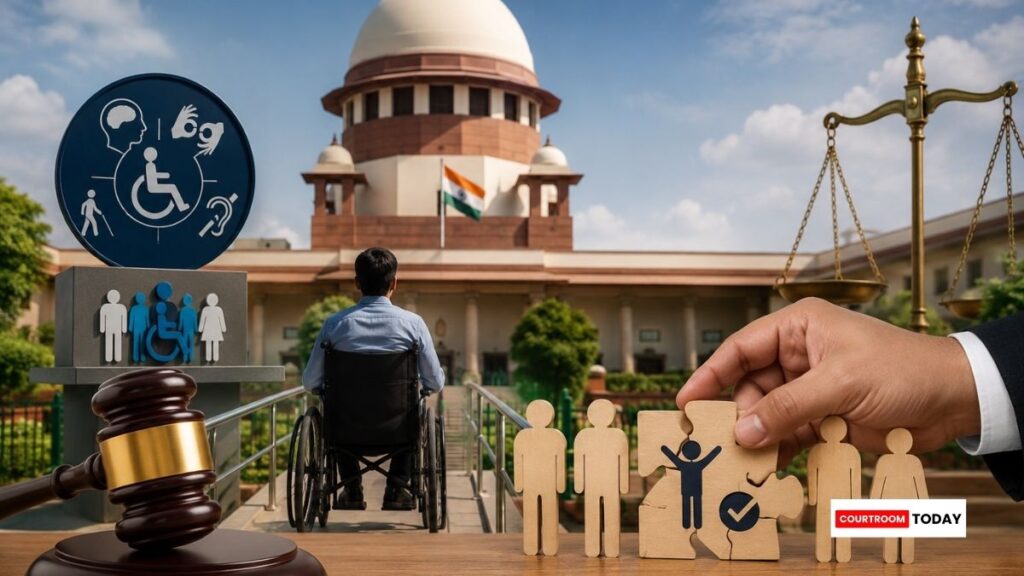
In Justice Sunanda Bhandare Foundation v. Union of India, the Supreme Court has directed the Centre, States and Union Territories to ensure that Persons with Benchmark Disabilities (PwBDs) who score above the general category cut-off are accommodated in unreserved vacancies on their own merit. The Court said this “upward movement” policy must be implemented strictly to protect equality and inclusion under the Rights of Persons with Disabilities Act, 2016.
A bench of Justices Vikram Nath and Sandeep Mehta passed the order while examining the implementation of reservation policies for persons with disabilities in recruitment and promotions.
The issue before the Court was whether PwBD candidates who qualify on their own merit above the unreserved cut-off should still be counted against the reserved disability quota. Earlier, in September 2025, the Court had expressed concern that denying such candidates general category seats would defeat the objective of the disability rights law.
During the latest hearing, the Union Government referred to Office Memoranda issued by the Department of Personnel and Training in 2018 and 2022. These instructions clarify that PwBD candidates selected without availing relaxed standards must be adjusted against unreserved vacancies and not against reserved quota seats.
The policy further states that candidates using relaxed standards such as lower cut-off marks, age relaxation or extra attempts would be counted under the reserved category. However, the use of scribes or compensatory time would not be treated as a relaxed standard.
The Court also noted that disability itself cannot be treated as a relaxed standard while assessing medical fitness for determining “own merit.” It accepted the Union’s stand that reservation for PwBD candidates functions horizontally across categories while ensuring meritorious candidates are not deprived of unreserved seats.
Endorsing the policy, the Court observed:
“Having considered the aforesaid affidavit and the policy framework placed on record, we are satisfied that the Union of India has adequately addressed the query raised in paragraph 53 of the judgment and order dated 12th September, 2025.”
The bench further stated:
“We, accordingly, endorse the said position and exhort the Union of India, as well as all States and Union Territories, to scrupulously adhere to and implement the policy of upward movement in its true letter and spirit, so as to advance the constitutional mandate of equality, dignity and inclusion for persons with disabilities.”
Apart from reservation issues, the Court also expressed concern over poor implementation of the Rights of Persons with Disabilities Act, 2016. It observed that even after eight years of the law coming into force, effective compliance by States and Union Territories remained “elusive.”
To strengthen monitoring, the Court directed eight National Law Universities working under “Project Ability Empowerment” to continue assessing implementation of the Act across States and Union Territories. It specifically assigned National Law University Delhi the responsibility of evaluating compliance by the Union Government.
The Court also granted a final opportunity to the Union Territories of Lakshadweep and Ladakh to appoint nodal officers for implementation of the disability law. The matter will next be heard on September 22, 2026.
——————————————–
Have a case update, article, or deal to share? Courtroom Today welcomes contributions from lawyers, law firms, and legal professionals. Write to contact@courtroomtoday.com