Supreme Court Dismisses PIL Seeking Full Newspaper Copies for Times of India Readers
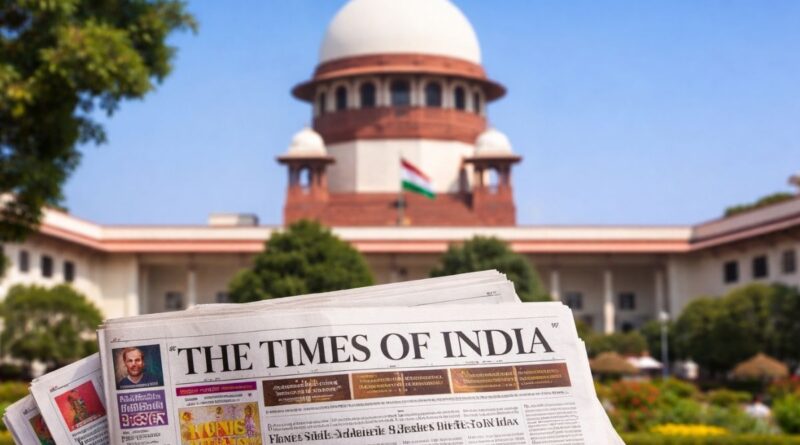
In GS Rathore v. Union of India and Anr, the Supreme Court recently dismissed a Public Interest Litigation (PIL) that sought directions to ensure that readers of the Times of India receive complete copies of the newspaper along with all supplements and magazines.
The petition was filed by Gauri Shanker Rathore, who claimed that readers were not receiving full copies of the newspaper, including Sunday magazines and supplementary sections. He alleged that this practice amounted to discrimination and unfair treatment of newspaper buyers.
The case was heard by a Bench comprising Justice Vikram Nath and Justice Sandeep Mehta. During the hearing, the Court questioned whether such a grievance could be entertained under Article 32 of the Constitution.
The petitioner requested the Court to issue directions to the Central government and the Times of India to ensure that complete newspaper copies were supplied to all readers. He also sought orders preventing any alleged cheating of consumers through missing supplements or reduced page numbers.
In addition, the petitioner made an unusual prayer asking the Court to direct the newspaper to donate ₹10 crore to animal shelters or other welfare initiatives.
Rathore argued that the newspaper had created discriminatory categories while supplying editions and supplements to readers. According to him, such practices lacked any “intelligible differentia and rational nexus,” thereby violating principles of equality.
However, the Bench was not convinced that the matter required constitutional intervention. The judges observed that the issue appeared to be a private or consumer dispute rather than a matter suitable for adjudication under Article 32.
The Court also raised a fundamental question about whether the Times of India, being a private entity, could be treated as a “State” for the purpose of filing a writ petition under Article 32.
“You can’t come in Article 32,” the Bench remarked while advising the petitioner to resolve the issue directly with his newspaper vendor.
The judges suggested that the petitioner could simply ask his local hawker to provide all the supplements and the Sunday magazine along with the newspaper.
Despite this suggestion, Rathore maintained that the issue affected many members of the public and that he had already written to the newspaper regarding the matter.
“The public is suffering. I have already written to them,” he told the Court.
Responding in a lighter tone, the Bench suggested an alternative approach. The Court remarked that a social media campaign might be more effective in bringing attention to the issue.
“You should start a social media campaign against Times of India. They’ll come running to your house. As it is, newspapers are facing a lot of difficulty,” the Court observed.
Ultimately, the Supreme Court dismissed the petition, indicating that the grievance did not warrant intervention under the Court’s writ jurisdiction.
——————————————–
Have a case update, article, or deal to share? Courtroom Today welcomes contributions from lawyers, law firms, and legal professionals. Write to contact@courtroomtoday.com