
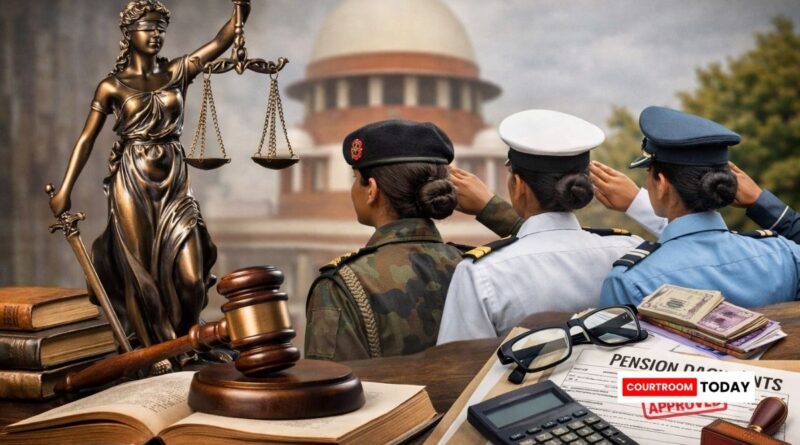
Supreme Court Grants Pension Relief to Women Officers Denied Permanent Commission
The Supreme Court, in a significant ruling concerning women officers in the armed forces, has granted pensionary benefits to those denied Permanent Commission (PC) due to flawed assessments. The decision came in a batch of petitions, including those filed by Wing Commander Sucheta Edan and others.
The bench comprising Chief Justice Surya Kant and Justices Ujjal Bhuyan and N Kotiswar Singh held that women Short Service Commission (SSC) officers in the Army, Navy, and Air Force would be treated as having completed the minimum qualifying service of 20 years for pension purposes.
This direction applies even if the officers were released earlier from service. The Court recognised that many women officers were denied Permanent Commission due to systemic and arbitrary evaluation practices that affected their career progression and long-term benefits.
While reading the operative portion of the judgment, the Chief Justice highlighted serious concerns regarding the evaluation process. He noted, “The ACRs were written with the presumption that they would not undergo career progression. This adversely affected their overall merit.”
The Court examined the policies governing all three branches of the armed forces and found several inconsistencies. In the case of the Air Force, the bench observed that the “Service Length Criteria” and “Minimum Performance Criteria” introduced in 2019 were implemented hastily.
According to the Court, such sudden policy changes deprived officers of a fair opportunity to meet the revised standards. This resulted in the unjust denial of Permanent Commission to several deserving candidates.
Invoking its extraordinary powers under Article 142 of the Constitution, the Court issued a one-time relief. It directed that all SSC women officers considered for PC in selection boards between 2019 and 2021, including those released in 2021, shall be deemed to have completed 20 years of qualifying service.
The pension benefits for these officers will be calculated based on this deemed service period and will take effect from November 1, 2025. This measure aims to correct the financial disadvantage suffered by the officers due to flawed evaluation mechanisms.
However, the Court declined to grant reinstatement to the affected officers. It cited concerns related to “operational effectiveness” but clarified that such considerations cannot justify the denial of financial entitlements arising from past service.
In relation to the Army and Navy, the Court found similar shortcomings in the assessment systems. It pointed out that the lack of transparency in evaluation criteria had adversely impacted the officers’ chances of securing Permanent Commission.
The Court also rejected the demand for notional promotions to higher ranks, such as Wing Commander, for officers who were no longer in active service. The detailed judgment in the matter is awaited.
This ruling marks a crucial step towards addressing gender-based disparities in the armed forces and reinforces the principle of fairness in service-related evaluations.
——————————————–
Have a case update, article, or deal to share? Courtroom Today welcomes contributions from lawyers, law firms, and legal professionals. Write to contact@courtroomtoday.com