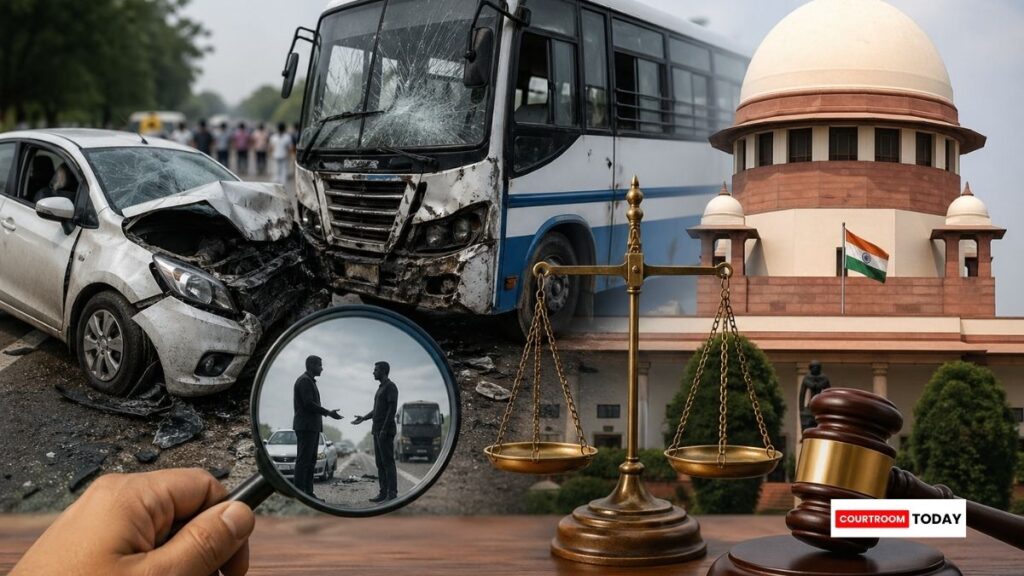
In Parmila & Ors. v. Rajender & Ors., the Supreme Court of India clarified that liability in head-on collision cases cannot be fixed on one driver alone without a proper and balanced evaluation of all circumstances.
The Court emphasised that determining negligence in motor accident cases requires a careful examination of the conduct of all parties involved. It held that attributing complete blame to one driver, especially in head-on collisions, without analysing factors like the manner of driving and point of impact, is legally flawed.
A bench of Justice Vikram Nath, Justice Sandeep Mehta, and Justice Vijay Bishnoi set aside the findings of the Motor Accident Claims Tribunal and the Punjab and Haryana High Court. Both had earlier held the deceased car driver solely responsible for a fatal accident involving a Haryana Roadways bus.
The Court expressed concern over the absence of any finding on contributory negligence. It noted that completely excluding the role of the bus driver, without examining his conduct, raised serious doubts about the correctness of the conclusions reached by the lower courts.
The case involved a tragic accident in which two individuals travelling in a car lost their lives. Their legal heirs had approached the Tribunal seeking compensation. However, all claims were dismissed after the Tribunal held that the deceased driver alone was negligent.
The Supreme Court found that the bus driver had not even entered the witness box, yet was fully absolved of responsibility. It observed that such an approach fails to meet the standards of fair adjudication and undermines the principles governing motor accident claims.
Another key issue highlighted by the Court was the failure to decide whether the bus driver possessed a valid driving licence. The Tribunal had framed this issue but chose not to give any finding on it, considering it unnecessary after absolving the driver of negligence.
The Court held that such non-adjudication renders the decision incomplete. It pointed out that the validity of a driving licence is crucial not only for determining liability between parties but also for assessing the overall legality of the findings.
Further, the Court noted that the bus driver was allegedly undergoing training at the time of the accident. This made the question of his competence and authorisation even more significant and central to the case.
In light of these deficiencies, the Supreme Court set aside the earlier judgements and remanded the matter back to the Tribunal for fresh consideration, directing a comprehensive re-evaluation of all relevant aspects.
——————————————–
Have a case update, article, or deal to share? Courtroom Today welcomes contributions from lawyers, law firms, and legal professionals. Write to contact@courtroomtoday.com