
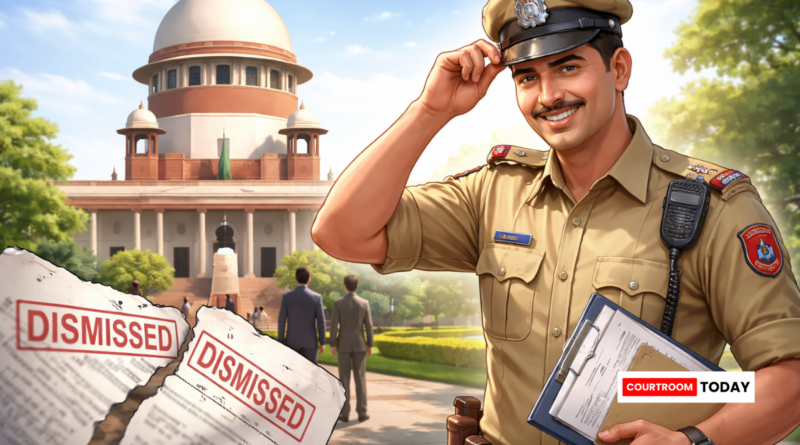
Supreme Court Reinstates Delhi Police Constable, Says Departmental Enquiry Cannot Be Skipped Without Evidence
In Manohar Lal v. Commissioner of Police & Ors., the Supreme Court held that a government employee cannot be dismissed without a departmental enquiry merely on the basis of assumptions. The Court reinstated a Delhi Police constable who had been removed from service without following the mandatory disciplinary procedure.
The judgement was delivered by a bench comprising Justice J.K. Maheshwari and Justice Atul S. Chandurkar. The Court emphasised that the constitutional protection under Article 311(2) cannot be bypassed casually by administrative authorities.
The case arose after a Delhi Police constable posted in the Special Cell was arrested following the registration of an FIR accusing him of robbery and criminal conspiracy under the Indian Penal Code. While he was still in custody, the Deputy Commissioner of Police dismissed him from service.
The dismissal order relied on Clause (b) of the second proviso to Article 311(2) of the Constitution. This provision allows authorities to remove a public servant without conducting a departmental enquiry if it is not “reasonably practicable” to hold such an enquiry.
The disciplinary authority argued that the constable could threaten or intimidate witnesses if a regular enquiry was conducted. Based on this presumption, the authorities decided to dispense with the departmental proceedings and directly terminate his service.
The constable challenged the dismissal before the Central Administrative Tribunal, but the Tribunal dismissed his plea. His writ petition before the Delhi High Court was also rejected, prompting him to approach the Supreme Court.
The Supreme Court carefully examined whether the authorities had sufficient material to justify bypassing the departmental enquiry. The Court observed that the power to dispense with an enquiry is an exception and cannot be exercised lightly.
It noted that the Deputy Commissioner’s report did not mention any specific incident showing that the constable had threatened or intimidated witnesses. At the time of the dismissal order, the officer was already in judicial custody.
The Court held that a mere assumption that witnesses might be influenced is not enough to invoke the exception under Article 311(2)(b). Authorities must rely on objective material demonstrating that conducting a departmental enquiry is genuinely impracticable.
Quoting its earlier ruling in Jaswant Singh v. State of Punjab (1991), the Court reiterated that the decision to dispense with an enquiry cannot be based solely on the “ipse dixit” of the authority concerned.
“The decision to dispense with the departmental enquiry cannot, therefore, be rested solely on the ipse dixit of the concerned authority. When the satisfaction of the concerned authority is questioned in a court of law, it is incumbent on those who support the order to show that the satisfaction is based on certain objective facts and is not the outcome of the whim or caprice of the concerned officer.”
The bench also pointed out that there was no evidence suggesting that the constable had links with criminals who could influence witnesses on his behalf. Without such supporting material, the apprehension expressed by the authorities remained speculative.
Accordingly, the Court set aside the orders of the Central Administrative Tribunal and the Delhi High Court. The dismissal order passed by the Deputy Commissioner of Police was also quashed.
The Supreme Court directed that the constable be reinstated with continuity of service. However, considering that a criminal case against him is still pending, the Court limited his back wages to 50 percent for the period between dismissal and reinstatement.
The Court clarified that the authorities remain free to initiate a regular departmental enquiry in accordance with law. The judgement reinforces that constitutional safeguards for public servants cannot be diluted through administrative convenience.
——————————————–
Have a case update, article, or deal to share? Courtroom Today welcomes contributions from lawyers, law firms, and legal professionals. Write to contact@courtroomtoday.com