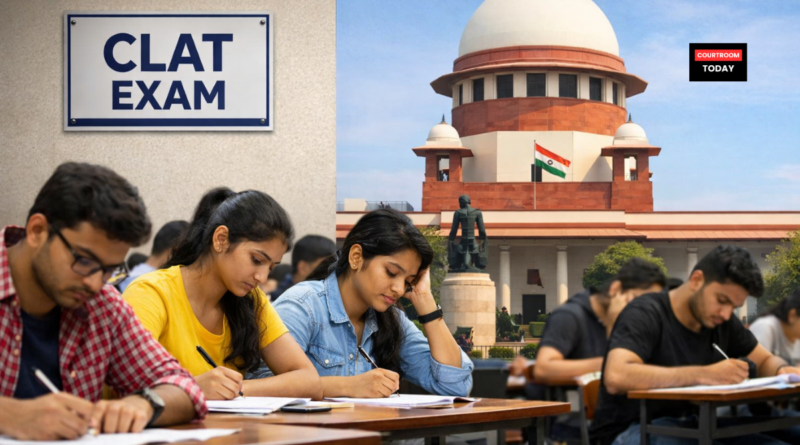
Supreme Court Rejects Plea Seeking Probe into Alleged CLAT 2026 Paper Leak
The Supreme Court of India has refused to entertain a plea seeking a court-monitored and time-bound investigation into the alleged leak of the Common Law Admission Test (CLAT) 2026 question paper.
A Bench of Justice PS Narasimha and Justice Alok Aradhe noted that the examination had already been conducted and questioned why the petitioners approached the Court at a late stage.
During the hearing, the Bench pointed out that if the alleged leak took place on December 6, the petition should have been filed earlier. The judges remarked that approaching the Court before the declaration of results would have been more appropriate.
The petition was filed by a group of law aspirants who alleged that images, videos, and digital content showing the CLAT 2026 question paper and answer key were circulated on platforms such as WhatsApp and Telegram even before the examination. According to the petitioners, some of these materials carried time stamps from the night of December 6, nearly 15 hours before the exam began.
Appearing for the petitioners, advocate Malvika Kapila argued that the plea was filed within a reasonable time and clarified that the petitioners were not seeking a direction to reconduct the exam immediately. Despite these submissions, the Bench declined to intervene and rejected the plea.
CLAT 2026 was held on December 7, 2025, from 2 PM to 4 PM across 156 test centres in 25 states and 4 Union Territories. The examination is conducted by the Consortium of National Law Universities and is the main entrance test for admission to undergraduate and postgraduate law programmes in 25 National Law Universities. This year, over 92,000 candidates competed for around 5,000 seats.
The plea highlighted that many of the petitioners belonged to Scheduled Caste, Other Backward Classes, and economically weaker sections, and claimed that genuine candidates were unfairly affected by the alleged leak. It was also pointed out that some social media posts appeared authentic, as they did not show signs of being edited and even included messages offering access to the paper for money.
The petitioners argued that the alleged leak had compromised the fairness of the examination and disturbed the level playing field expected in a national entrance test. They further contended that allowing counselling and seat allotment to proceed would cause irreversible harm to deserving candidates.
The plea also referred to the grievance redressal mechanism set up by the Consortium under former Supreme Court judge Justice MR Shah, stating that no clear report or response had been shared with candidates who raised complaints.
Ultimately, the Supreme Court refused to order any independent or court-monitored inquiry into the matter, bringing the legal challenge to an end.
——————————————–
Have a case update, article, or deal to share? Courtroom Today welcomes contributions from lawyers, law firms, and legal professionals. Write to contact@courtroomtoday.com