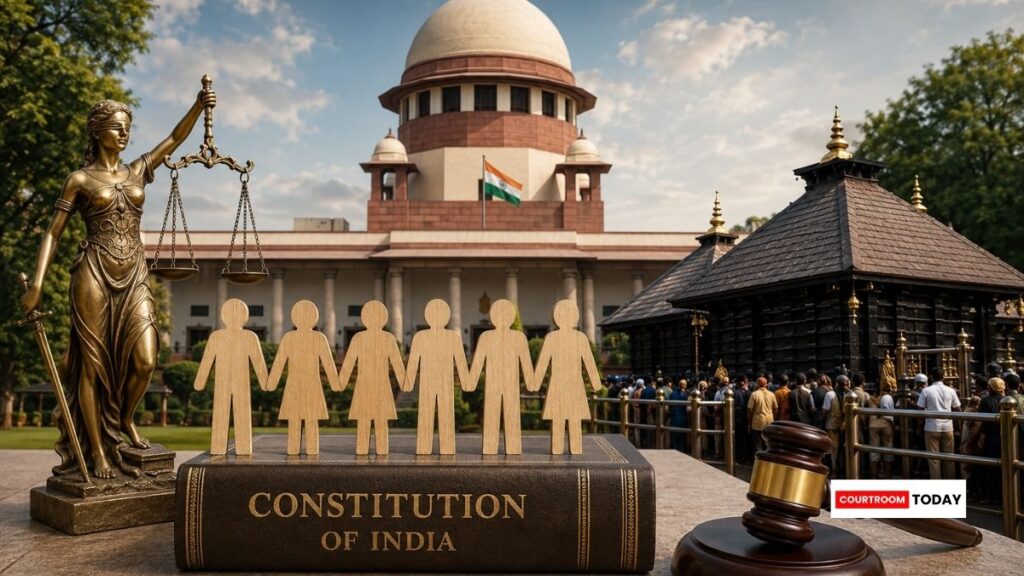
In the Sabarimala reference matter, a nine-judge Bench of the Supreme Court on Thursday reserved its judgement after hearing arguments for 16 days on the scope of religious freedom under the Constitution. The Bench examined the relationship between Articles 25 and 26 and whether denominational rights under Article 26 operate independently of other fundamental rights.
The proceedings largely focused on the phrase “subject to other provisions of this Part” appearing in Article 25. Justice BV Nagarathna repeatedly questioned the interpretation advanced by several parties that Articles 14 to 24 automatically override religious freedoms protected under Articles 25 and 26.
According to Justice Nagarathna, Articles 25 to 28 form a distinct group dealing specifically with religion and therefore must be interpreted together. She observed that rights concerning religion cannot be read in a manner that completely weakens denominational protections guaranteed under Article 26.
During the hearing, she stated that Articles dealing with equality and other constitutional guarantees should be juxtaposed with similarly placed religious rights instead of being mechanically imposed on matters of faith. She also expressed reservations about applying Article 17 to gender-based exclusion in religious practices.
The issue arose in the context of the 2018 Sabarimala judgment, where former Chief Justice DY Chandrachud had linked restrictions on women’s entry with the constitutional prohibition on untouchability. Justice Nagarathna questioned whether Article 17 was intended to address gender exclusion at all.
Senior Advocate Gopal Subramanium supported the interpretation that Articles 25 to 28 should be read harmoniously. He argued that constitutional expressions such as “religious practice” and “matters of religion” indicate a broader protection for denominational autonomy.
Solicitor General Tushar Mehta also argued that principles like arbitrariness and intelligible differentia under Article 14 cannot be applied in the same way to religious beliefs. According to him, courts must assess religious practices from the perspective of believers rather than through conventional equality tests.
Subramanium further argued that the nature of individual rights under Article 25 differs from collective denominational rights under Article 26. He submitted that once a person becomes part of a denomination, the internal rules and tenets of that denomination become significant.
Justice MM Sundresh, however, observed that an individual’s freedom is equally valuable. Responding to this, Subramanium stated that disputes involving denominational practices may require civil remedies rather than constitutional challenges.
Senior Advocates CS Vaidyanathan, Abhishek Manu Singhvi and Rakesh Dwivedi also presented differing views on how Part III rights interact with religious freedoms. While some argued that Articles 14 and 15 cannot directly apply against religious denominations, others suggested that certain rights like Articles 17 and 23 may still influence religious practices.
Amicus Curiae K Parmeshwar urged the Court not to permanently exclude the application of Articles 14, 19 and 21 in religious matters. He cautioned that future disputes involving bodily integrity or extreme practices may require constitutional balancing.
The Bench hearing the matter comprises Chief Justice of India Surya Kant, Justice BV Nagarathna, Justice MM Sundresh, Justice Ahsanuddin Amanullah, Justice Aravind Kumar, Justice Augustine George Masih, Justice Prasanna B Varale, Justice R Mahadevan and Justice Joymalya Bagchi.
——————————————–
Have a case update, article, or deal to share? Courtroom Today welcomes contributions from lawyers, law firms, and legal professionals. Write to contact@courtroomtoday.com