Supreme Court Reserves Verdict on Plea to Withdraw Life Support of Man in Vegetative State Since 2013
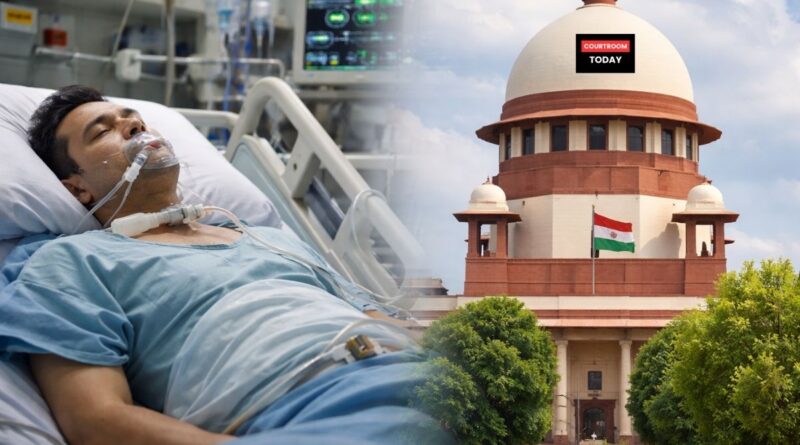
The Supreme Court of India on Thursday reserved its verdict in Harish Rana v. Union of India, a case concerning the withdrawal of life-sustaining treatment for Harish Rana, a 31-year-old man who has remained in a permanent vegetative state since 2013.
A Bench of Justice JB Pardiwala and Justice KV Viswanathan described the matter as extremely sensitive, observing that courts deal with legal disputes daily, but deciding questions of life and death involves profound ethical and moral considerations. The Bench remarked that judges are “mortals” and must act with great restraint while dealing with such cases.
Harish Rana suffered a severe traumatic brain injury in August 2013 after falling from the fourth floor of his paying guest accommodation in Chandigarh, where he was pursuing a BTech degree. Since then, he has remained in a permanent vegetative state with no signs of recovery.
His parents approached the Court seeking permission to withdraw life-sustaining treatment, specifically clinically assisted nutrition and hydration (CANH), which is being administered through a PEG tube. According to the family, this treatment merely sustains biological functions and does not offer any realistic chance of improvement.
Earlier, the parents had moved the Delhi High Court seeking the constitution of a Medical Board to examine Rana’s condition and consider withdrawal of life support in line with the Supreme Court’s guidelines on passive euthanasia. However, the High Court declined relief, holding that Rana was not on mechanical life support and was not terminally ill. It therefore concluded that the question of passive euthanasia did not arise.
The family challenged this decision before the Supreme Court in 2024. While the top court initially declined to grant relief, it allowed the parents the liberty to approach it again if further directions became necessary.
As Rana’s condition remained unchanged and medically irreversible, his father filed the present petition. Representing the family, Advocate Rashmi Nandakumar submitted that Rana has suffered 100 per cent disability and clearly meets the medical criteria of a permanent vegetative state. She argued that continuing CANH only prolongs biological survival without dignity.
Referring to earlier judgments of the Supreme Court, including those recognising the right to die with dignity as part of Article 21 of the Constitution, she contended that once the Medical Boards conclude that withdrawal of life-sustaining treatment is appropriate, the legal process should come to an end.
Additional Solicitor General Aishwarya Bhati, assisting the Court, informed the Bench that directions issued in earlier end-of-life cases remain largely unimplemented. She also pointed to the severe deterioration in Rana’s condition, noting that he shows no meaningful response to external stimuli.
After hearing all parties at length, the Supreme Court reserved its verdict in Harish Rana v. Union of India.
——————————————–
Have a case update, article, or deal to share? Courtroom Today welcomes contributions from lawyers, law firms, and legal professionals. Write to contact@courtroomtoday.com