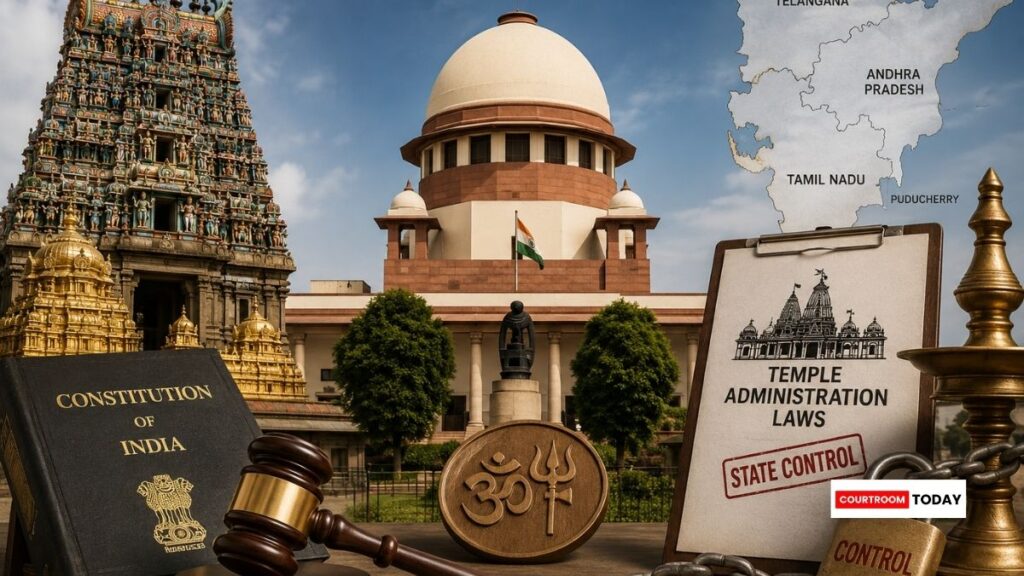
In Swami Dayananda Saraswathi vs State of Tamil Nadu, the Supreme Court has decided to examine the constitutional validity of laws that allow State control over Hindu temples and religious endowments in Tamil Nadu, Andhra Pradesh, Telangana and Puducherry. The matter will now be heard on merits after the Court recalled its earlier 2025 order.
A Bench of Justices BV Nagarathna and Satish Chandra Sharma revived the batch of petitions on Monday. Earlier, in April 2025, the Court had asked the petitioners to approach the respective High Courts instead of continuing before the Supreme Court.
The petitions were originally filed in 2012. They challenge provisions of the Tamil Nadu Hindu Religious and Charitable Endowments Act, 1959, the Andhra Pradesh Charitable and Hindu Religious Institutions and Endowments Act, 1987, the Telangana Hindu Religious and Charitable Endowments Act, 1987 and the Pondicherry Hindu Religious Institutions Act, 1972.
The challenged provisions relate to powers given to Commissioners, appointment of executive officers and trustees, auditing of temple accounts, use of temple surplus funds, supervision of religious institutions and control over temple properties.
The petitioners argued that these laws violate constitutional protections under Articles 14, 19, 25, 26 and 31A. They claimed that Hindu religious denominations have a constitutional right to manage their own religious affairs without excessive State interference.
Article 25 guarantees freedom of religion, while Article 26 protects the rights of religious denominations to manage their own institutions. The petitioners argued that the State’s involvement in temple administration crosses constitutional limits.
In its April 2025 order, the Supreme Court had observed that the laws of different States may have distinct schemes. Because of this, it had directed the petitioners to move the respective High Courts, stating that local courts could better analyse historical, cultural and religious aspects connected to each law.
The petitioners challenged that order through review petitions. They argued that the Tamil Nadu, Andhra Pradesh and Puducherry laws originated from the same Madras HR&CE legislative framework and therefore followed a common pattern.
They further submitted that sending them to different High Courts after 13 years of litigation would create unnecessary hardship and multiple proceedings. The petitioners also stressed that Article 32 gives citizens a direct right to approach the Supreme Court for protection of fundamental rights.
The review petitions also relied on earlier litigation connected to temple administration laws, including the well-known Shirur Mutt judgement. According to the petitioners, provisions previously struck down were later reintroduced through subsequent enactments.
Accepting the review pleas, the Supreme Court has now decided to hear the constitutional challenge itself. The matter is expected to become a significant hearing on the extent of State control over Hindu religious institutions in South India.
——————————————–
Have a case update, article, or deal to share? Courtroom Today welcomes contributions from lawyers, law firms, and legal professionals. Write to contact@courtroomtoday.com