Supreme Court Says Community Acceptance Key to Reclaim Scheduled Caste Status
In Chinthada Anand v State of Andhra Pradesh and Ors., the Supreme Court has clarified when a person from a Scheduled Caste can regain that status after converting to another religion and later re-converting. The ruling brings clarity to a legally sensitive and socially significant issue.
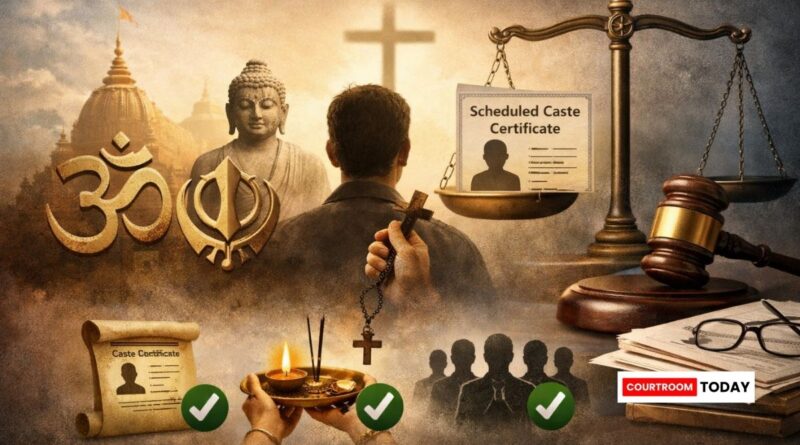
The Court stated that a person belonging to a Scheduled Caste loses that status immediately upon converting to a religion other than Hinduism, Sikhism, or Buddhism. This position flows directly from the Constitution (Scheduled Castes) Order, 1950, which limits recognition to these three religions.
The bench of Justice Prashant Kumar Mishra and Justice Manmohan emphasised that re-conversion alone does not automatically restore Scheduled Caste status. Instead, strict conditions must be fulfilled before such a claim can be accepted by law.
Firstly, the individual must clearly establish that they originally belonged to a caste recognised as a Scheduled Caste under the 1950 Order.
Secondly, there must be strong and credible evidence of genuine re-conversion. The Court stressed that this involves more than a formal declaration. The person must completely renounce the earlier religion and genuinely adopt the customs, practices, and traditions of the original religion.
Thirdly, the individual must prove acceptance by the original caste community. The Court made it clear that self-identification is not enough. The community must recognise and accept the individual as one of its members, reflecting true social assimilation.
The Court held that all three conditions are mandatory. Failure to satisfy even one would make the claim invalid. Importantly, the entire burden of proof lies on the person seeking to reclaim Scheduled Caste status.
The case arose from a plea filed by a pastor who was originally from a Scheduled Caste but had converted to Christianity. He later sought protection under the Scheduled Castes and Scheduled Tribes (Prevention of Atrocities) Act, 1989.
However, his claim was rejected as Christianity is not included under the 1950 Order. The Court reaffirmed that conversion to such a religion leads to automatic loss of Scheduled Caste status, and legal protections linked to it cannot be claimed thereafter.
The Court also briefly noted that for Scheduled Tribes, religion is not the determining factor. Instead, individuals must show continued adherence to tribal customs and acceptance by the tribal community.
——————————————–
Have a case update, article, or deal to share? Courtroom Today welcomes contributions from lawyers, law firms, and legal professionals. Write to contact@courtroomtoday.com