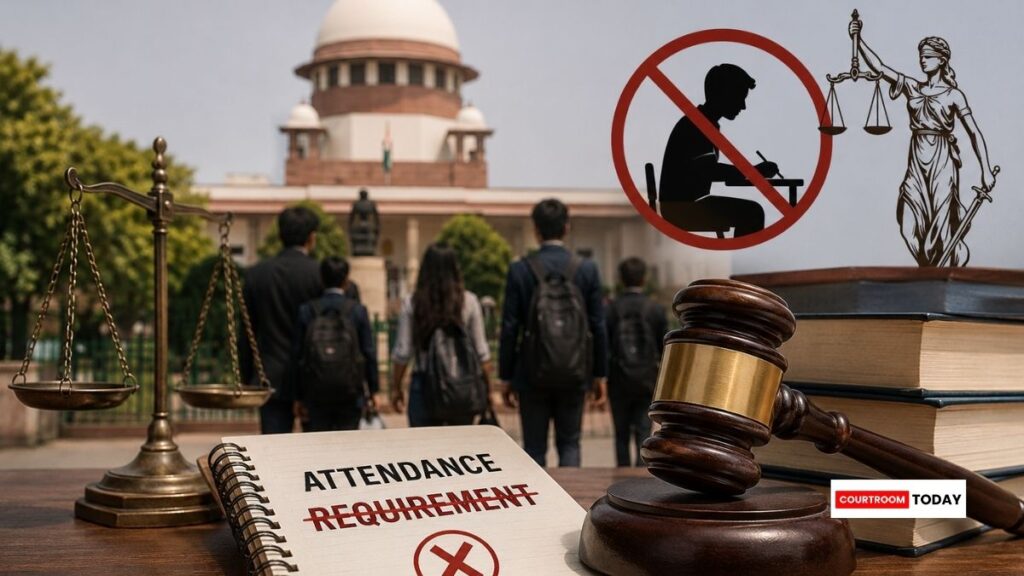
The Supreme Court has stayed a key direction issued by the Delhi High Court in the case concerning attendance requirements in law colleges. The matter relates to the Delhi High Court’s November 2025 judgement which had held that law students could not be stopped from appearing in examinations solely because of low attendance.
A Bench of Justices Vikram Nath and Sandeep Mehta passed the interim order while hearing petitions filed by the Bar Council of India and other institutions challenging the High Court verdict.
The Supreme Court ordered that paragraph 249 of the Delhi High Court judgement would remain stayed prospectively till further hearing. The matter is now listed for July 21.
During the hearing, the Court observed that several National Law Universities were facing difficulties after the High Court decision. The Bench remarked that many students were opposing compulsory attendance requirements and noted that even former students were supporting the challenge to mandatory attendance norms.
The Bench also questioned the Bar Council of India over the delay in filing its challenge against the High Court judgement. BCI Chairman and Senior Advocate Manan Kumar Mishra admitted before the Court that there had been a lapse in approaching the Supreme Court earlier.
Senior Advocate Mukul Rohatgi, appearing for Narsee Monjee Institute of Management Studies (NMIMS), argued that the Delhi High Court ruling had weakened academic discipline in law colleges. He submitted that students were increasingly seeking permission to appear for exams despite attendance shortages.
The Supreme Court orally observed that the High Court had “literally legislated” through its directions and questioned whether the judgement effectively created a right for students to avoid attending classes.
However, the top court clarified that High Courts across the country would still be free to independently decide similar attendance-related matters pending before them.
The controversy traces back to a suo motu PIL initiated by the Delhi High Court after the 2017 death of law student Sushant Rohilla at Amity University. It was alleged that Rohilla faced harassment over attendance shortages and was forced to repeat an academic year, circumstances which allegedly contributed to his suicide.
Apart from the attendance dispute, the Supreme Court also heard a petition challenging biometric attendance systems in law colleges. The petitioner argued that there were no adequate safeguards for protection of students’ biometric data and raised concerns regarding private agencies handling such information. The Court stated that the issue would also be taken up on July 21.
——————————————–
Have a case update, article, or deal to share? Courtroom Today welcomes contributions from lawyers, law firms, and legal professionals. Write to contact@courtroomtoday.com