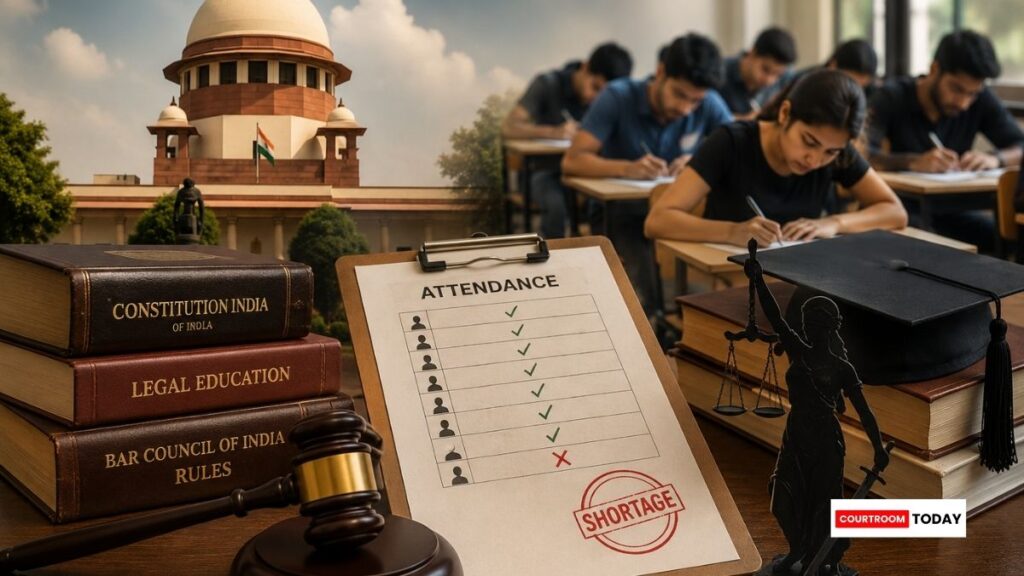
In Narsee Monjee Institute of Management Studies vs. Bar Council of India, the Supreme Court on Wednesday agreed to examine whether law students can be prevented from appearing in examinations due to shortage of attendance, while refusing to immediately stay a Delhi High Court ruling that had favoured students.
A Bench of Justice Vikram Nath, Justice Sandeep Mehta and Justice Vijay Bishnoi issued notice to the Bar Council of India on a petition filed by Narsee Monjee Institute of Management Studies challenging the Delhi High Court’s November 2025 judgement.
The top court, however, declined to suspend the High Court decision for now. The Bench observed, “We are not suspending that order. We will hear the matter, decide and lay down the correct position of law.”
During the hearing, Senior Advocate Mukul Rohatgi, appearing for NMIMS, argued that the High Court’s ruling had weakened the purpose of attendance rules in legal education.
“The High Court says no attendance is required anywhere. People don’t want to go to colleges. I am wondering why we went to college then,” Rohatgi submitted before the Bench.
The Supreme Court also remarked that the practical effect of such a ruling could reduce law university hostels to “just boarding and lodging facilities” if students stop attending classes regularly.
The matter has now been linked with another pending batch of cases concerning BCI circulars on mandatory disclosures by law students relating to criminal background, employment status, simultaneous academic pursuits and attendance compliance.
The controversy began after the Delhi High Court ruled that students enrolled in recognised law institutions could not be barred from examinations or academic progression solely because of low attendance.
NMIMS argued before the Supreme Court that the High Court judgement had opened the floodgates for litigation by students seeking permission to write examinations despite not meeting attendance requirements.
The petition stressed that physical classroom learning remains essential in legal education, especially in five-year integrated law programmes where students enter directly after school. According to the plea, activities such as lectures, tutorials, moot courts and practical training cannot be fully replaced by internships or extracurricular engagements.
The institution further relied on Rule 12 of the BCI Rules on Legal Education, 2008, which prescribes a minimum attendance requirement of 70 percent, with limited relaxation allowed up to 65 percent in exceptional situations.
The plea also cited legal education systems in countries such as the United States, United Kingdom, Australia and Singapore to argue that attendance requirements are globally recognised standards in professional education courses.
NMIMS additionally referred to earlier Supreme Court rulings that emphasised limited judicial interference in decisions taken by expert academic and professional regulatory bodies regarding educational standards.
The petition challenging the Delhi High Court judgement was filed through advocate Kanu Agrawal.
——————————————–
Have a case update, article, or deal to share? Courtroom Today welcomes contributions from lawyers, law firms, and legal professionals. Write to contact@courtroomtoday.com