Supreme Court to Hear Open Court Review on 3-Year Practice Rule Mandating Bar Practice for Judicial Service
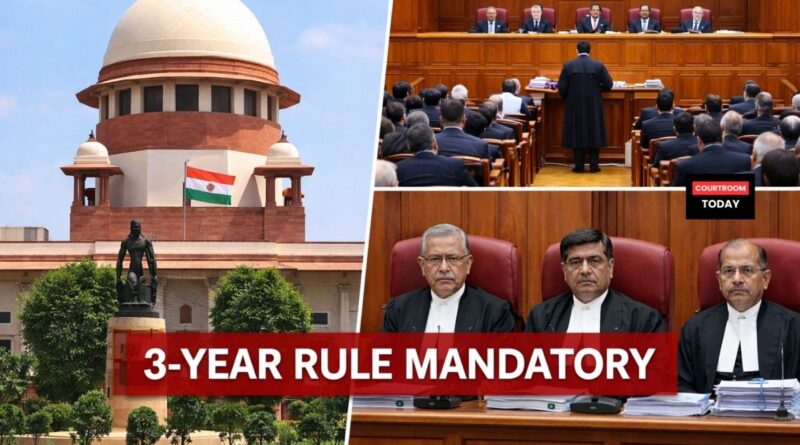
In Chandrasen Yadav v. Union of India and others, the Supreme Court has agreed to hear in open court the review petitions challenging its earlier decision that made three years’ practice at the Bar mandatory for entry-level judicial service. The matter will now be argued orally before the Court.
The order was passed by a Bench comprising Chief Justice of India Surya Kant, Justice Augustine George Masih and Justice K Vinod Chandran on February 10. The review pleas will be heard in open court on February 26.
Ordinarily, review petitions are decided in chambers without detailed oral submissions. An open court hearing at the review stage is uncommon and usually reserved for exceptional situations. The Court has also issued notices to all States and High Courts in the matter.
The review challenges the Supreme Court’s May 2025 judgement which restored the earlier rule requiring at least three years of advocacy practice for recruitment to the lower judiciary. The ruling brought back the pre-2002 position, stating that prior courtroom exposure ensures maturity and competence in trial court judges.
One of the petitions has been filed by Advocate Chandrasen Yadav. It argues that the Court did not properly consider the recommendations of the Shetty Commission, which had suggested removing the compulsory practice condition. According to the petitioner, structured judicial training can adequately prepare fresh graduates.
The plea also refers to the decision in All India Judges Association v. Union of India, where emphasis was placed on systematic training of judicial officers. The petitioner contends that a rigid practice requirement was never meant to override structured institutional preparation.
It has further been argued that the judgement relied heavily on affidavits from certain High Courts and State Governments supporting the practice condition. However, opposing views expressed by States such as Nagaland, Tripura and Chhattisgarh, and the Punjab and Haryana High Court, were allegedly not given adequate weight.
The review also questions the Court’s observation that fresh graduates are “raw”. It highlights that candidates already undergo a rigorous three-stage selection process consisting of preliminary examination, mains and viva voce, followed by professional training before assuming office.
The petition points out the absence of empirical data showing that advocates with less than three years’ practice perform poorly as judges. It also invokes State of West Bengal v. Anwar Ali Sarkar to argue that there must be a rational basis for classification under Article 14.
The review applicant has requested that, if the rule is to continue, it should be implemented prospectively from 2027. This, it is argued, would prevent hardship to graduates who planned their careers based on earlier eligibility conditions.
The petitions emphasise that the three-year rule affects fundamental rights under Articles 14, 16 and 19(1)(g) of the Constitution, including equality, equal opportunity in public employment and freedom to practise a profession. The forthcoming open court hearing is expected to clarify the constitutional balance involved.