Supreme Court To Revisit Definition Of “Industry”; 9-Judge Bench To Examine Labour Law Scope
The Supreme Court has decided to set up a nine-judge Constitution Bench to settle an important question: What exactly is an “industry” under labour laws, and do labour laws apply to State activities?
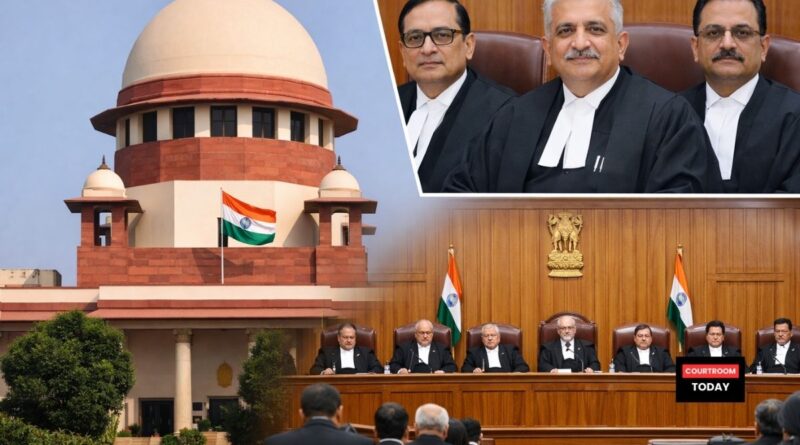
A Bench led by Chief Justice of India Surya Kant, along with Justices Joymalya Bagchi and Vipul M. Pancholi, said the larger Bench will begin hearing the matter on March 17 and is expected to conclude arguments the next day.
Why Is This Case Important?
The Constitution Bench will examine whether the landmark 1975 ruling in Bangalore Water Supply & Sewerage Board v. R Rajappa still lays down the correct legal position.
In that case, a seven-judge Bench had given a broad meaning to the term “industry” under the Industrial Disputes Act, 1947. The Court introduced a “triple test” to decide whether an organisation qualifies as an industry. According to that test, an organisation would be considered an industry if:
- It carries out systematic activity,
- There is organised cooperation between employer and employee, and
- It produces or distributes goods or services to satisfy human needs.
Because of this wide definition, labour law protections were extended to employees in clubs, hospitals, educational institutions and similar bodies.
What Will The Nine-Judge Bench Decide?
The larger Bench will now consider several key issues:
- Whether the legal test laid down in the 1975 judgment is correct.
- Whether the Industrial Disputes Amendment Act, 1982 — which has not been fully brought into force — has any legal impact on the definition of “industry.”
- Whether social welfare schemes and activities carried out by government departments can be treated as “industrial activities.”
- Which State functions, if any, fall outside the scope of Section 2(j) of the Industrial Disputes Act.
The Bench will also interpret the position under the Industrial Relations Code, 2020, which replaced the earlier labour law framework.
What Happened In Court?
The Court said that much of the case management process has already been completed. Parties have been allowed to update or file fresh written submissions by February 28, 2026.
Each side has been given a fixed time to argue the matter. Petitioners will get three hours to present their case and one additional hour for reply. The Court has asked the lawyers to coordinate among themselves to ensure that arguments finish within the set schedule.
This upcoming decision could significantly impact how labour laws apply to government departments, public bodies and welfare institutions across India.
——————————————–
Have a case update, article, or deal to share? Courtroom Today welcomes contributions from lawyers, law firms, and legal professionals. Write to contact@courtroomtoday.com