Supreme Court Upholds Creation of Kolhapur Bench of Bombay High Court
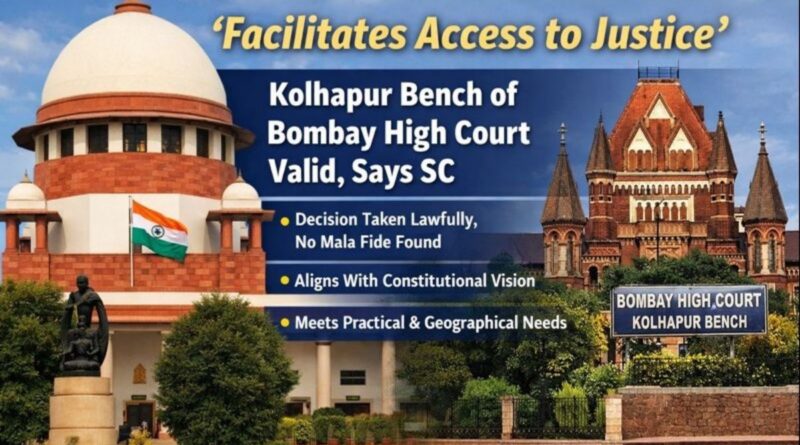
The Supreme Court on Wednesday dismissed a writ petition challenging the establishment of the Kolhapur Circuit Bench of the Bombay High Court, stating that the move aligns with the constitutional goal of making justice more accessible to people.
The petition was filed by advocate Ranjeet Baburao Nimbalkar, who questioned the August 1 notification issued under Section 51(3) of the States Reorganisation Act, 1956. The notification led to the formation of the Kolhapur Bench, which became operational from August 18.
A Bench comprising Justice Aravind Kumar and Justice NV Anjaria held that the decision to set up the Kolhapur Bench was taken within the legal framework and serves the larger public interest. The Court observed that the establishment of the bench reflects the constitutional vision of bringing justice closer to citizens, especially those living far from the principal seat of the High Court.
The Bench clarified that Section 51(3) preserves the authority of the Chief Justice of India in deciding matters related to the creation of High Court benches. It found no material to suggest that the decision was taken arbitrarily or without considering relevant institutional inputs.
The Court further noted that even if the consultative process did not meet the petitioner’s expectations, that alone would not invalidate the exercise of power under the law. In the absence of any proof of mala fide intent or clear illegality, there was no ground for judicial interference.
Addressing the argument that a different view had been taken earlier on setting up a bench at Kolhapur, the Court held that past opinions do not prevent authorities from revisiting the issue, provided the decision is taken bona fide and within statutory limits.
The Bench also rejected the claim that resources could have been better utilised elsewhere, stating that alternative policy views cannot invalidate a decision taken lawfully. It emphasised that the Constitution does not prescribe a single model for judicial administration and allows flexibility to meet practical and geographical needs.
The petitioner had relied on the Jaswant Singh Commission’s 1985 report, which suggested that benches away from the principal seat should be an exception. He also referred to the Supreme Court’s judgment in Federation of Bar Associations v. Union of India (2000), arguing that wider judicial consultation was necessary. However, the Court accepted the justification offered by the State Government and the Bombay High Court, including multiple representations seeking a bench at Kolhapur.
The Kolhapur Bench was inaugurated in August by former Chief Justice of India BR Gavai.
——————————————–
Have a case update, article, or deal to share? Courtroom Today welcomes contributions from lawyers, law firms, and legal professionals. Write to contact@courtroomtoday.com