The Emergence of Protection of Personality Rights in India
In the digital era where identity is itself a tradable and monetisable commodity, Indian law is increasingly pressed to answer a basic question: “Who controls a person’s persona?”
Public figures across domains now routinely approach courts, complaining that their faces, voices, names and even characteristic gestures are being exploited without consent to be monetised, often through manipulated videos, fake endorsements and AI-generated deepfakes. As theIndian law still lacks a dedicated statute governing personality rights, Indian courts have pieced together protection through constitutional privacy, intellectual property regimes and equitable doctrines.
This article traces the emergence of personality rights in India, the key judicial milestones, the recent spike in AI- and deepfake-driven litigation, and the fragmented legal framework that currently governs the field. While courts have been agile in adapting old doctrines to new harms, the time is ripe for a coherent statutory regime.
Introduction
The legal system was not designed for a world in which a person’s face can be algorithmically grafted onto another’s body, or their voice synthetically cloned and manipulated at scale. Yet such technologies are now easily accessible and widely deployed.
Indian courts increasingly encounter disputes over fake endorsements, manipulated images and videos of celebrities, the unauthorised use of public figures’ names in titles, and deepfakes created to mislead, defame or commercially exploit their reputation. The common grievance is simple but profound: identity is being appropriated without consent.
What are Personality Rights
Personality rights, internationally akin to the “right of publicity”, protect an individual’s control over the commercial and reputational use of their identity—name, image, likeness, voice, signature and other distinctive attributes. These rights occupy a hybrid space. On one hand, identity is deeply personal: unauthorised manipulation of images or voice can humiliate and damage reputation and undermine autonomy, aligning personality rights with privacy and dignity.
On the other, for celebrities and public figures, persona functions as a valuable economic asset at the heart of endorsement markets and brand-building, thereby resembling an intangible property interest.
Evolution of Personality Rights in Indian Jurisprudence
India has no codified right of publicity. Instead, courts have evolved personality rights through constitutional interpretation, intellectual property principles and equitable remedies. A foundational decision is R. Rajagopal v. State of Tamil Nadu, where the Supreme Court recognised a right to safeguard the privacy of one’s life and personal information, and warned against unauthorised publication of a person’s life story. Though the case focused on press freedom, it laid the groundwork for identity-based claims.
In Shivaji Rao Gaekwad v. Varsha Productions, the Madras High Court protected the persona of actor Rajinikanth, restraining use of his name and style in the film “Main Hoon Rajnikanth”. The court recognised that the name and persona of a reputed celebrity represent the individual to the public and that unauthorised use could deceive viewers and harm reputation, warranting an injunction.
A more elaborated articulation came from the Delhi High Court in Titan Industries v. Ramkumar Jewellers, where the plaintiff’s brand Tanishq had lawfully engaged Amitabh and Jaya Bachchan, but the defendant used their images on hoardings without consent. Drawing on the U.S. decision in Haelan Laboratories v. Topps Chewing Gum, the court defined the right of publicity as the right to control commercial use of human identity and emphasised that the wrong lies in denying the celebrity control over “when, where and how” their identity is used.
It outlined two core elements: an enforceable right in a human persona, and identifiability of the celebrity from the unauthorised use, without requiring proof of confusion or deception.
The Delhi High Court in Anil Kapoor v. Simply Life India further broadened the scope, extending protection beyond name and physical resemblance to features such as voice, gestures and catchphrases, thereby recognising the composite nature of a celebrity’s persona.
Constitutionally, Justice K.S. Puttaswamy v. Union of India marked a turning point. The nine-judge bench held privacy to be a fundamental right under Article 21, intrinsically linked to dignity, autonomy and liberty, giving a firmer constitutional footing to control over personal identity. In Krishna Kishore Singh v. Sarla A. Saraogi, concerning the late actor Sushant Singh Rajput, the Delhi High Court recognised that a living person can claim publicity rights but declined to extend those rights posthumously, signalling judicial caution on the temporal scope of such rights.
Through these decisions, courts have steadily acknowledged that celebrity identity possesses independent commercial value and that its unauthorised appropriation for gain is an actionable wrong.
Recent Litigation Trend
Recent years have seen a surge of suits by public figures—such as Hrithik Roshan, Akshay Kumar and Aishwarya Rai—seeking injunctions against unauthorised exploitation of their persona and AI-generated deepfakes. The distinguishing feature of this new wave is the centrality of technology: deepfakes now replicate faces, voices and gestures with uncanny accuracy, fuelling fake endorsements for financial products, cryptocurrencies, political messaging and obscene content.
Given the viral speed of digital circulation and the near-irreversibility of reputational harm once content spreads, courts have increasingly granted ad-interim injunctions and ordered immediate takedown of offending material from online platforms. This marks a shift toward proactive judicial protection of digital identity.
Legal Framework in India
In the absence of a dedicated “Personality Rights Act”, the protection of persona is currently stitched together from constitutional, statutory and common law doctrines. Constitutionally, Puttaswamy anchors personality rights in Article 21’s guarantee of privacy and dignity: unauthorised manipulation or commercial exploitation of identity can be framed as an affront to personal autonomy, not merely as economic loss.
Under the Copyright Act, Section 2(qq) defines “performer” and identifies those whose work qualifies for specific protection; Section 38 grants enforceable rights to performers, limiting unauthorised commercialisation of their performances; and Section 57 protects moral rights, allowing performers to claim authorship and prevent distortion or mutilation prejudicial to their reputation. These provisions indirectly safeguard aspects of persona embedded in performances.
The Trade Marks Act provides another layer. Section 14 restricts unauthorised use of the names or representations of living persons (and certain well-known deceased persons) in trademarks, while Section 27(2) preserves the common law action of passing off. Celebrities may also seek registration of distinctive elements of persona—names, voices, dialogues and recognisable traits—though even without formal registration, passing off enables them to challenge false suggestions of endorsement where they can show goodwill, misrepresentation and likely damage.
Procedurally, Indian courts have relied heavily on “John Doe” or “Ashok Kumar” orders, which permit ex parte interim injunctions against unknown defendants. Such orders are particularly useful where infringers operate anonymously online, in cases of large-scale piracy, unauthorised image exploitation or AI-driven impersonation. Decisions such as Abhishek Bachchan v. Bollywood Tea Shop, Karan Johar v. India Pride Advisory (P) Ltd. and Akkineni Nagarjuna v. WWW.BFXXX.ORG reflect this trend, with the Delhi and Bombay High Courts granting swift injunctions against fake videos, deepfakes and misleading endorsements created with AI tools. John Doe orders thus help translate doctrinal recognition of personality rights into effective, time-sensitive protection in the digital sphere.
Conclusion
Indian personality rights have evolved along a clear arc: from privacy and dignity, to protection against commercial misappropriation, and now towards safeguarding digital identity in an era dominated by AI and pervasive media technologies. Courts have displayed doctrinal creativity in stretching existing frameworks to respond to new harms, but the overall regime remains judge-made and fragmented rather than legislative and comprehensive.
As artificial intelligence increasingly blurs the line between the real and the fabricated, the central policy question is whether personality will continue to be protected only incidentally—through privacy, copyright, trademark and passing off—or recognised as a coherent right in its own terms through a dedicated statute.
The future trajectory of personality rights in India will depend not only on judicial sensitivity but also on whether the legislature chooses to convert this evolving jurisprudence into a structured statutory framework capable of balancing human dignity, commercial interests and freedom of expression.
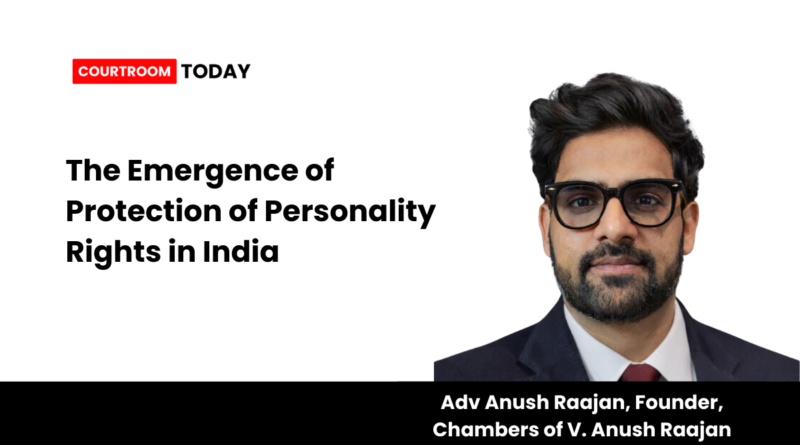
Author: Adv Anush Raajan, Founder, Chambers of V. Anush Raajan. The views expressed are personal.
——————————————–
Have a case update, article, or deal to share? Courtroom Today welcomes contributions from lawyers, law firms, and legal professionals. There are no charges. Write to contact@courtroomtoday.com