
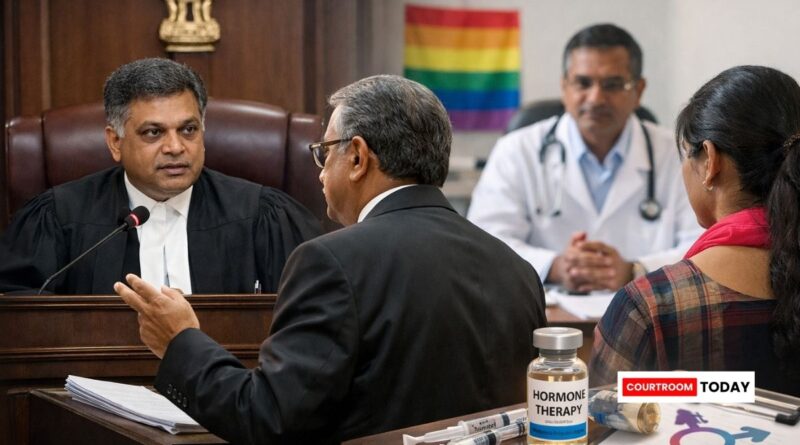
Transgender Amendment Act Under Scrutiny by Kerala High Court: Asks Centre Whether Hormone Therapy, Sex Change Halted
The Kerala High Court is examining concerns surrounding the Transgender Persons (Protection of Rights) Amendment Act, 2026, particularly its impact on ongoing medical treatments. The issue arose in petitions filed by transgender individuals who claimed that their hormone therapy was abruptly halted after the law came into effect.
Justice Bechu Kurian Thomas sought clarification from the Central government on whether gender-affirming procedures, including hormone therapy, are restricted under the amended law. The Court specifically asked how the new provisions affect individuals already undergoing treatment.
The petitions highlighted that hospitals have stopped hormone replacement therapy citing the amended legislation. Senior Advocate Arundhati Katju, appearing for one of the petitioners, stated, “Their physical and emotional health rests on this. This treatment is being stopped due to this Amendment.”
The Court questioned whether individuals in the middle of transition would be impacted. It observed that relief could be granted individually rather than staying the law entirely, noting that some petitioners were already undergoing gender transition.
Responding to the Court, Additional Solicitor General P Sreekumar stated, “That is not the fault of the provision. It is a practical issue which is to be dealt with separately.” The Court has now directed the Centre to seek instructions and explain the rationale behind the amendments.
One of the petitions challenges key changes introduced by the 2026 amendment, arguing that it removes the concept of self-identification and imposes mandatory medical certification. It is contended that this shift contradicts the principles laid down in the NALSA judgment of 2014.
The petitioner, a transwoman, stated that she had already obtained a transgender identity card and updated official documents under the earlier law. She had also begun hormone therapy and planned surgery, which is now uncertain due to both medical risks and legal changes.
It was further argued that the requirement of medical certification violates the right to privacy under Article 21, as recognised in the Puttaswamy judgement. The petition also raised concerns about access to legal remedies and support systems following the amendment.
Another key contention is that the revised definition of “transgender person” under Section 2(k) narrows its scope. According to the petitioner, this excludes individuals who identify based on self-perceived gender identity but do not fall within socio-cultural categories.
The plea also highlights broader social consequences, including distress within the transgender community. It states that many individuals are facing psychological pressure due to fear of exclusion and loss of recognition.
The Court declined to stay the law, observing that statutes carry a presumption of constitutionality. However, it acknowledged the urgency of the situation and has listed the matter for further hearing on April 10.
——————————————–
Have a case update, article, or deal to share? Courtroom Today welcomes contributions from lawyers, law firms, and legal professionals. Write to contact@courtroomtoday.com