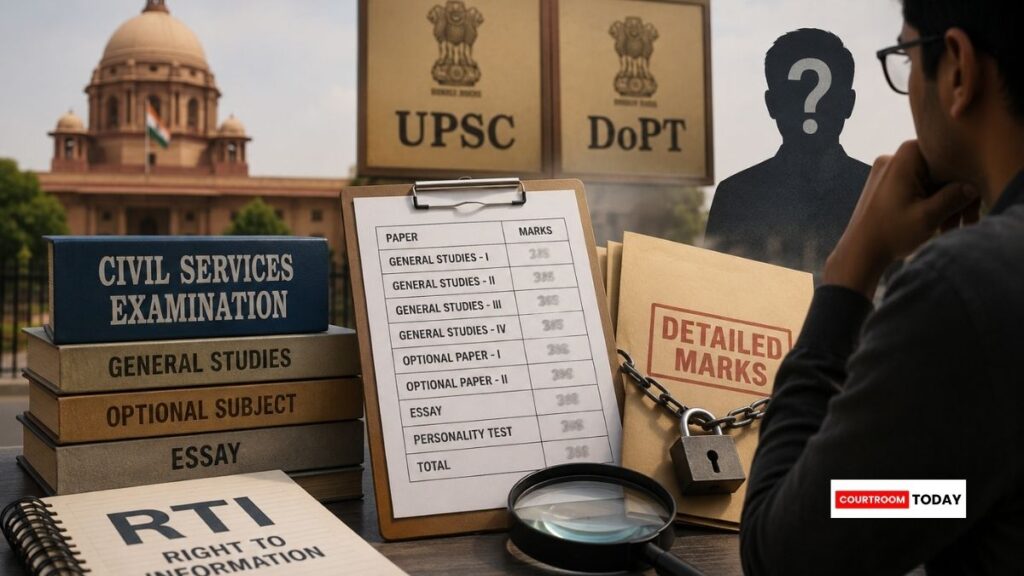
The case of Aniket Kumar Gupta v. CPIO, UPSC & Anr. has brought fresh attention to the transparency of the Civil Services Examination process after the Central Information Commission questioned the Union Public Service Commission and the Department of Personnel and Training over the discontinuation of publishing paper-wise marks of successful candidates.
The Central Information Commission observed that UPSC and DoPT failed to clearly explain why the practice of disclosing detailed marks was stopped after the Civil Services Examination 2017. Earlier, UPSC used to publish marks obtained by recommended candidates in General Studies papers, optional subjects, Essay, and Personality Test separately.
The matter arose from an RTI application filed by UPSC aspirant Aniket Kumar Gupta under the Right to Information Act, 2005. Gupta argued that since 2018, UPSC has only been publishing aggregate written marks and interview scores without giving a subject-wise breakup. According to him, this lack of transparency creates confusion among aspirants while selecting optional subjects.
During the hearing, the appellant submitted that coaching institutes often use unofficial claims regarding “high-scoring” optional subjects and toppers’ performances to attract students. He argued that the absence of official paper-wise data particularly affects candidates from weaker backgrounds who depend on publicly available information while preparing for the examination.
UPSC defended its stand by claiming that detailed subject-wise marks are “personal information” and therefore exempt from disclosure. The DoPT also supported the non-disclosure policy, stating that publication of detailed marks may lead to misuse by coaching institutes and may create misleading impressions among aspirants.
However, the CIC found contradictions in the explanations given by the two authorities. While the DoPT claimed that subject-wise marks are maintained solely by UPSC, UPSC informed the Commission that such information is shared with DoPT as part of the examination process.
The Commission also noted that UPSC could not produce any official circular, policy document, file noting, or written instruction explaining the decision to stop publishing paper-wise marks. The CIC remarked that the submissions were largely based on “institutional memory” rather than documentary evidence.
The order recorded that UPSC itself confirmed during the hearing that there was no direction issued by it to DoPT for discontinuing publication of bifurcated marks. At the same time, DoPT’s written submission stated that subject-wise marks were prepared and retained only by UPSC.
The Commission further observed that the authorities failed to answer the appellant’s argument regarding selective use of the “personal information” exemption under the RTI Act. It noted that the reasons behind ending the earlier practice remained unclear.
Accordingly, the CIC directed the DoPT to submit detailed written explanations along with supporting records, policy decisions, circulars, and file notings within six weeks. The Commission also asked the department to explain why it should not recommend restoring the earlier practice of publishing detailed paper-wise marks of recommended Civil Services Examination candidates.
——————————————–
Have a case update, article, or deal to share? Courtroom Today welcomes contributions from lawyers, law firms, and legal professionals. Write to contact@courtroomtoday.com