
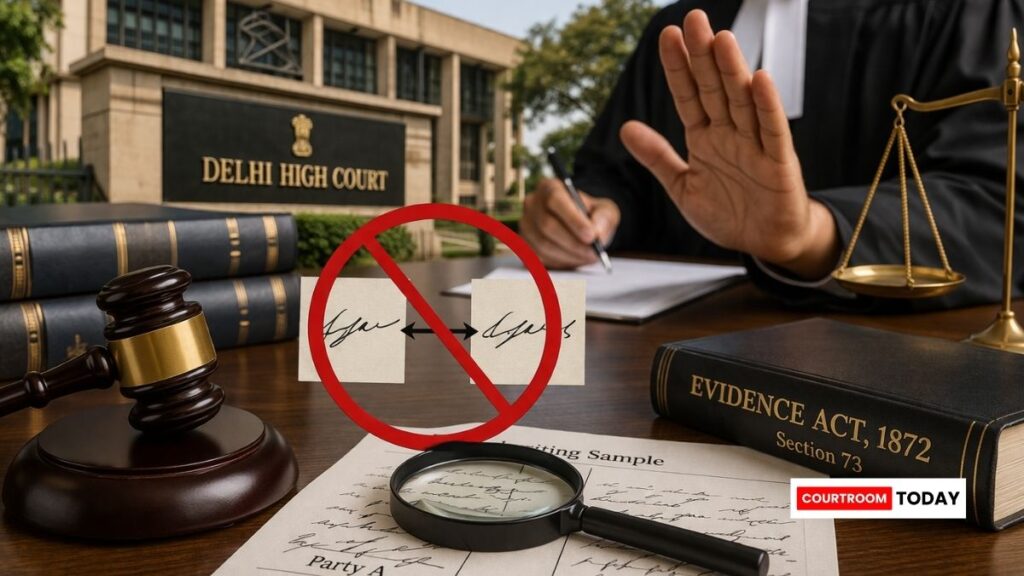
The Delhi High Court has set aside a divorce decree after finding that a Family Court compared handwriting samples on its own without first informing the parties. The High Court said such a course cannot be adopted in a manner that takes a party by surprise.
The ruling came from a Bench of Justices Vivek Chaudhary and Renu Bhatnagar. The Court made it clear that any comparison of handwriting under Section 73 of the Evidence Act must follow a fair process and cannot bypass the basic rules of natural justice.
The dispute began in a matrimonial case where the husband accused his wife of cruelty. To support his case, he relied on a handwritten slip which allegedly contained certain demands made by the wife. That document became an important part of the trial court proceedings.
During the case, the Family Court asked both sides to write sample lines. It later compared those writings on its own and concluded that the disputed slip had been written by the wife. The court also drew an adverse inference from her reluctance to provide handwriting samples.
The High Court found serious fault with this approach. It said the wife had not been told that the samples were being taken specifically for comparison by the court. She was also not given a proper opportunity to respond to that proposed use of her handwriting.
The Bench observed, “Raising an adverse inference against a party, on account of her resistance for giving her handwriting, without informing her that the same will be used by the Court for comparison purposes, is against the principles of natural and fair justice and cannot be sustained.”
The Court further said, “The exercise of this provision requires awareness of the parties as a pre-requisite for procedural fairness…the comparison is required to be undertaken sparingly,” stressing that such judicial comparison should not become a routine shortcut in contested proceedings.
It also noted that courts may seek expert assistance where necessary. In this matter, however, no expert opinion was taken. The High Court said the manner in which the Family Court proceeded gave the impression that it was supporting a pre-determined conclusion instead of carefully testing the evidence.
Apart from the handwriting issue, the High Court also found that the remaining allegations of cruelty were not backed by sufficient evidence. It held that the burden of proof had been wrongly shifted and that the divorce decree could not be allowed to stand on such a weak foundation.
As a result, the High Court allowed the wife’s appeal and set aside the 2011 divorce decree granted under Section 13(1)(ia) of the Hindu Marriage Act. The judgement reinforces that even in family disputes, fairness in procedure is as important as the final outcome.
——————————————–
Have a case update, article, or deal to share? Courtroom Today welcomes contributions from lawyers, law firms, and legal professionals. Write to contact@courtroomtoday.com