India’s data center industry is facing a foundational challenge that it cannot “compute” its way out of. It is the quintessential problem faced by most countries trying to create AI data center dominance at home. A single hyperscale AI training cluster consumes power that is equivalent to a small township. However, unlike human settlements, the power needs of an AI data center needs to be continuous and not seasonal i.e. it needs power that never switches off. This power source, unlike what the most cutting-edge renewable energy solutions can provide so far, needs to be reliable and dense. This is existential for the AI stack that India is building.
Enter recently the Sustainable Harnessing and Advancement of Nuclear Energy for Transforming India Act, 2025 (SHANTI). SHANTI, the most credible legislative solution to this problem, aims to consolidate and modernize India’s legal framework while allowing (rather enabling) private participation in the nuclear sector, albeit under tight yet more liberalized regulatory oversight than ever seen in India. SHANTI is potentially the most consequential energy statute since the (Indian) Electricity Act, 2003.
It is only recently after the technology community has been slowly connecting the dots that SHANTI’s implications for the AI and data center sector are beginning to be understood. The architectural shift in law is fundamental. Private entities will be permitted to: (a) Build, (b) Own, (c) Operate, and (d) Decommission nuclear power plants in India. The nuclear sector is clearly now open for business.
SHANTI also removes supplier liability and caps operator liability based on the plant capacity. This is an essential step taken by India to align with international nuclear liability conventions. This is a reform that quietly addresses why global nuclear suppliers, vendors and sector participants previously avoided Indian projects. Combined with customs duty exemptions on input materials for nuclear power plants until 2035, the fiscal and legal signal to capital markets is clear: the nuclear sector in India is now investible.
For hyper-scalers and data center operators, the strategic implications are immediate. Small modular reactors (SMRs), which SHANTI explicitly facilitates, are particularly suited to co-location with compute infrastructure. Nuclear energy is expected to provide a reliable baseload power source for emerging technologies. This is not just a question of AI but also quantum computing, data intensive research and India’s ambitions for setting up domestic semiconductor manufacturing. SHANTI provides for a licenseable configuration for an SMR to power a Tier-3 data center campus.
Alongside civilian AI infrastructure, the same SMR architecture has a natural adjacency to the defense sector. Forward deployed, hardened nuclear micro-reactors could potentially anchor energy sovereignty of India’s most sensitive military compute and communications installations, reducing dependency on vulnerable grid infrastructure.
It is during times of such key legislative reforms where practicing lawyers and general counsel become architects and not simple notaries or spectators. The legal work required to operationalize the vision that SHANTI now enables to execute is layered but urgent. Lawyers must engage with the AERB’s newly acquired statutory independence to help shape the cleansing frameworks that govern nuclear and data center co-location. A configuration that SHANTI does not intrinsically prescribe. Secondly, the appellate structure under Section 51 of SHANTI designates the appellate tribunal for electricity as the appellate authority, meaning nuclear energy disputes will travel through electricity law jurisprudence. This is a hybrid domain demanding cross-disciplinary expertise. Thirdly, FDI policy for nuclear independent power producers remains to be fully defined by DPIIT.
The most visionary opportunity lies in imagining a data center stack analogous to India’s UPI architecture. Not a single platform but a layered interoperable, open standard framework. Just as UPI separated payment rails form the application layer, India could architect a nuclear compute stack (with sovereign fuel cycle and safety at the base retained by DAE). Private IPP operated SMR generation in middle layer and competitively accessible compute capacity. This can be sold as atomic powered cloud credits. SHANTI provides the foundational statute for all of this. What is needed now is secondary delegated legislation, model PPAs between nuclear IPPs and data center operators, a fit-for-purpose grid interconnection framework for captive nuclear generation; and ultimately, ultimately, a “Nuclear Digital Mission” that brings together the forte of the Ministry of Power, MeitY and DAE in a coordinated multi-disciplinary, multi-sectoral policy.
The window for this advocacy is narrow as the rules under SHANTI are still being drafted. Those who engage now with shaping the subordinate legislation (whether in drafting rooms, DPIIT consultations or the AERB regulatory process itself) will define the sector’s architecture for a generation. India missed its semiconductor moment. However, it cannot afford to miss the nuclear-compute convergence. The atoms are ready. Algorithms are waiting silently in the backdrop. But for now, the lawyers need to get to work and the question is whether they are ready to step up to this convergence.
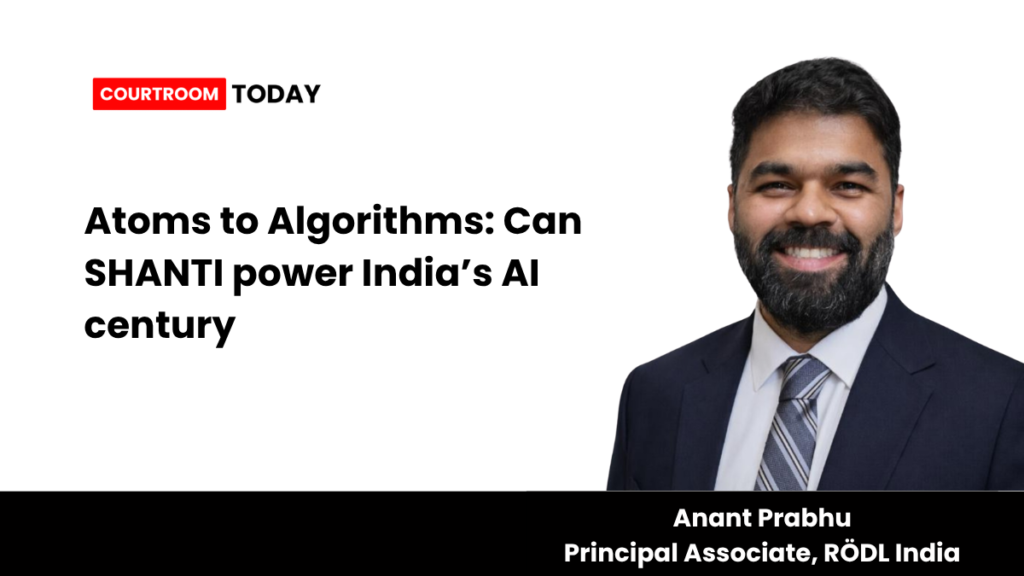
Mr. Anant Prabhu is a corporate-commercial lawyer leading Mergers & Acquisitions in Mumbai at Rödl India, with a practice spanning TMT, emerging technologies, and cross-border regulatory strategy.
——————————————–
Have a case update, article, or deal to share? Courtroom Today welcomes contributions from lawyers, law firms, and legal professionals. Write to contact@courtroomtoday.com