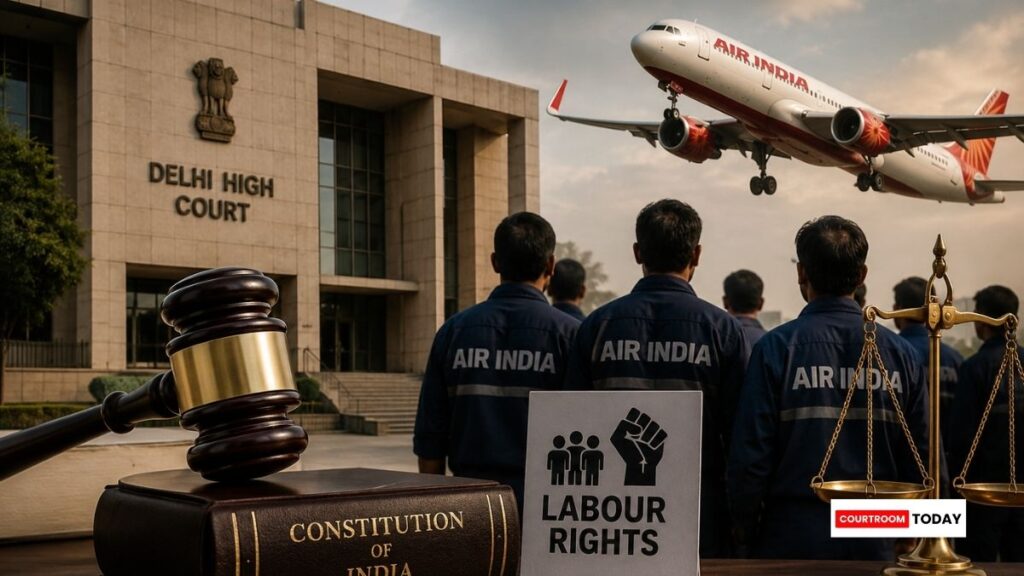
In Sauraj Singh v. M/S Indian Airlines Ltd And Anr., the Delhi High Court has clarified that Air India’s privatization does not prevent employees from challenging Labour Court or Industrial Tribunal awards before the High Court under Articles 226 and 227 of the Constitution.
Justice Shail Jain delivered the ruling while hearing petitions filed by former Air India and Indian Airlines workers, along with employee unions. The petitions challenged awards passed by the Central Government Industrial Tribunal (CGIT), which had granted compensation instead of reinstatement after declaring their termination illegal.
The dispute involved casual workers engaged between 1993 and 1998 in roles such as helpers, drivers, and support staff. The CGIT had earlier found that their termination violated Section 25-F of the Industrial Disputes Act, 1947 because they were removed without notice or retrenchment compensation despite completing over 240 days of service.
Even after holding the termination illegal, the CGIT chose to award compensation ranging from ₹25,000 to ₹55,000 instead of reinstating the workers.
Before the High Court, Air India argued that since the airline was privatized in 2022, it no longer qualifies as “State” under Article 12 of the Constitution. The airline relied on the Supreme Court’s judgement in R.S. Madireddy v. Union of India (2024) to contend that writ petitions against Air India were no longer maintainable.
However, the High Court rejected this argument and drew a distinction between the two situations.
The Court noted that in Madireddy, employees had directly approached the High Court against Air India without first using remedies available under labour laws. In the present matter, the petitions arose after adjudication by the CGIT under the Industrial Disputes Act.
The Court observed:
“Once a Labour Court or Industrial Tribunal renders an award, such award is subject to judicial review by the High Court under Articles 226/227. In such cases, the writ is directed against the adjudicatory process and the award itself, not merely the private entity.”
Justice Jain further stated that accepting Air India’s argument would make tribunal awards immune from judicial scrutiny, which could never have been the intention of the law.
The Court also referred to Section 17(2) of the Industrial Disputes Act and explained that although ordinary civil court challenges are barred and no statutory appeal exists, judicial review under Articles 226 and 227 remains available in cases involving illegality, perversity, or jurisdictional errors.
On the merits of the dispute, the High Court upheld the CGIT’s conclusion that the workers’ termination was illegal. However, it refused to order reinstatement considering that the employees were casual workers engaged for short periods nearly three decades ago.
The Court ultimately modified the tribunal’s award and disposed of the petitions.
——————————————–
Have a case update, article, or deal to share? Courtroom Today welcomes contributions from lawyers, law firms, and legal professionals. Write to contact@courtroomtoday.com