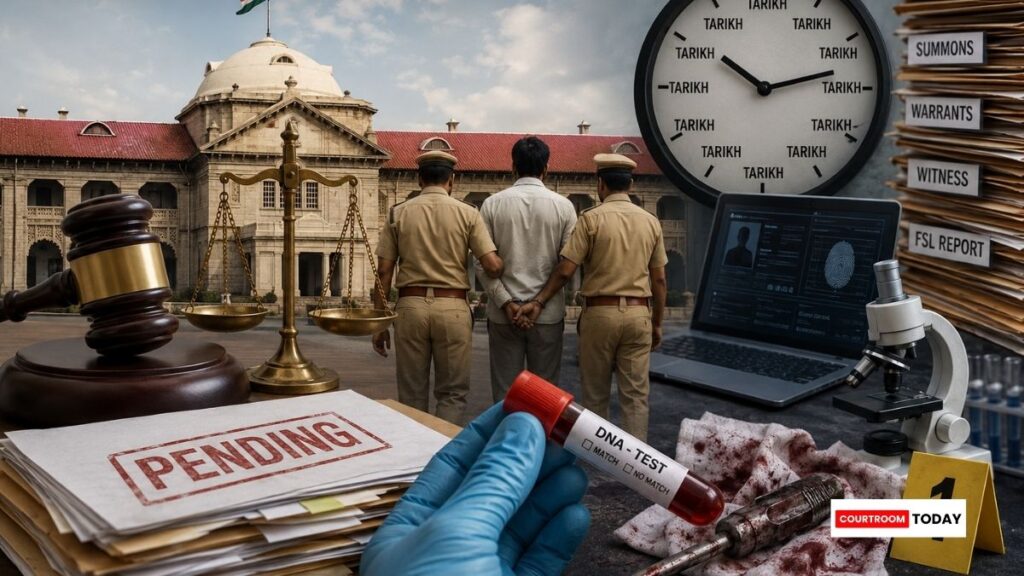
The Allahabad High Court, in Mevalal Prajapati vs State of UP, made strong remarks on the growing delay in criminal trials and said that judges alone cannot be blamed for the “Tarikh pe Tarikh” culture in courts. The Court said the State Government and police machinery are equally responsible for the massive pendency of criminal cases.
Justice Arun Kumar Deshwal referred to the famous dialogue from the film Damini and observed that the public often sees the judiciary as the sole reason for delays. However, the Court clarified that judicial officers cannot function effectively without proper infrastructure, adequate staff, timely forensic reports, and cooperation from the police.
The observations came during the hearing of a bail plea filed by a murder accused. The Court found serious lapses in investigation after it was revealed that the investigating officer failed to seek DNA matching from the Forensic Science Laboratory regarding blood found on a recovered screwdriver.
Concerned over the issue, the Court had summoned the Director General of Police, Secretary Home, and Director of the Uttar Pradesh FSL. During the proceedings, the FSL Director informed the Court that only eight out of twelve laboratories in the state have DNA profiling facilities. The labs are also facing shortage of staff and modern forensic equipment.
The Court was also informed that the FSL functions under the police department and lacks administrative independence to recruit staff or purchase instruments. The State Government stated that a proposal to make the FSL an autonomous body under the Home Department is under consideration.
The High Court observed that many honest and hardworking judicial officers become frustrated because of insufficient staff, poor police cooperation in executing summons and warrants, and defective investigations. It said the High Court itself cannot solve these structural issues unless the State Government takes corrective steps.
The bench further noted that delays in criminal trials allow many accused persons to continue public life without conclusion of proceedings. Referring to an Association for Democratic Reforms report, the Court noted that 49% of ministers in the Uttar Pradesh Government face criminal cases, while 44% face serious criminal charges.
The Court also raised concern over the safety of judicial officers. It observed that judges often face threats from criminals in courtrooms and public spaces. Unlike Punjab and Haryana, Uttar Pradesh does not provide personal security officers to all judicial officers, which affects fearless judicial functioning.
To address these issues, the Court issued several directions to the State Government and police authorities. These include filling vacancies in FSLs within one year, improving forensic infrastructure, training police officers in evidence collection, and ensuring attendance of senior police officials in monthly monitoring meetings chaired by District Judges.
The Court also directed police to adopt technology-driven reforms such as recording witness statements using Speech-to-Text AI modules under Section 180 BNSS and collecting verified digital communication details of accused and witnesses during investigations.
The bail plea was ultimately rejected after the Court considered the call detail records, recovery of the blood-stained weapon, and recovery of the victim’s e-rickshaw connecting the accused to the crime.
——————————————–
Have a case update, article, or deal to share? Courtroom Today welcomes contributions from lawyers, law firms, and legal professionals. Write to contact@courtroomtoday.com