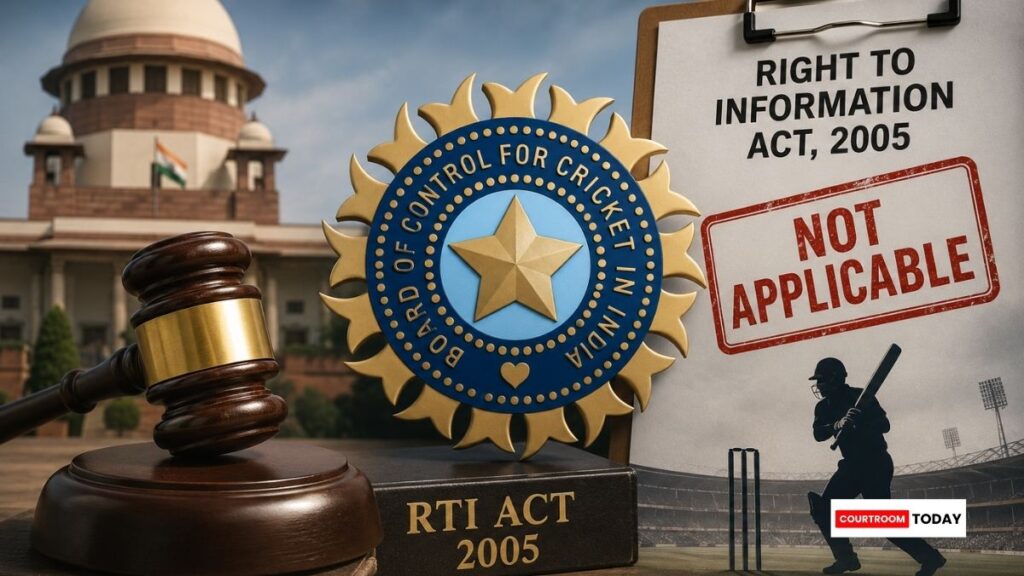
In a significant ruling, the Central Information Commission (CIC) has held in Geeta Rani v. Ministry of Youth Affairs and Sports that the Board of Control for Cricket in India is not a “public authority” under the Right to Information Act, 2005. The decision means that the BCCI cannot be compelled to disclose information under the RTI law.
The order was passed by Information Commissioner P R Ramesh while dismissing a second appeal filed by a Delhi resident who had sought details regarding the legal basis on which the BCCI represents India in international cricket and selects players for the national team.
The dispute began in 2017 when an RTI application was filed before the Ministry of Youth Affairs and Sports. The applicant sought information on the authority under which the BCCI selects players, the reasons governments provide infrastructure and security for cricket matches, and whether any government body exercises legal control over the organisation.
The Ministry replied that the requested information was not available with it. It also stated that the application could not be transferred to the BCCI because the cricket body had not declared itself a public authority under the RTI Act.
The issue had earlier taken a different direction in 2018 when the CIC, under then Information Commissioner M Sridhar Acharyulu, ruled that the BCCI qualified as a public authority. The Commission had directed the body to appoint Public Information Officers and comply with disclosure obligations under Section 4 of the RTI Act.
However, the BCCI challenged that ruling before the Madras High Court. In September 2025, the High Court sent the matter back to the CIC for reconsideration in light of the Supreme Court’s judgement in Board of Control for Cricket in India v. Cricket Association of Bihar.
After reconsidering the matter, the CIC concluded that the BCCI does not satisfy the requirements under Section 2(h) of the RTI Act. The Commission noted that the body was neither created under the Constitution nor established through a parliamentary or state law. It also observed that the BCCI is simply a society registered under the Tamil Nadu Societies Registration Act.
The Commission relied on Supreme Court rulings including Thalappalam Service Cooperative Bank Ltd v. State of Kerala, Dalco Engineering Pvt Ltd v. Satish Prabhakar Padhye, and Zee Telefilms Ltd v. Union of India. It held that public importance or regulatory supervision alone cannot convert a private entity into a public authority.
Rejecting arguments about government control, the CIC said there is no substantial control by the government over the BCCI’s finances, administration, management or affairs. It further observed that the organisation is financially independent and earns revenue through sponsorships, broadcasting rights and ticket sales.
The Commission also clarified that performing public functions, such as selecting the Indian cricket team, does not automatically attract RTI obligations because the law does not include “public function” as a test under Section 2(h).
The CIC additionally referred to the National Sports Governance Act, 2025, which extends RTI obligations to sports bodies receiving government grants. Since the BCCI does not receive such financial assistance, the Commission held that the law would not apply to it either.
——————————————–
Have a case update, article, or deal to share? Courtroom Today welcomes contributions from lawyers, law firms, and legal professionals. Write to contact@courtroomtoday.com