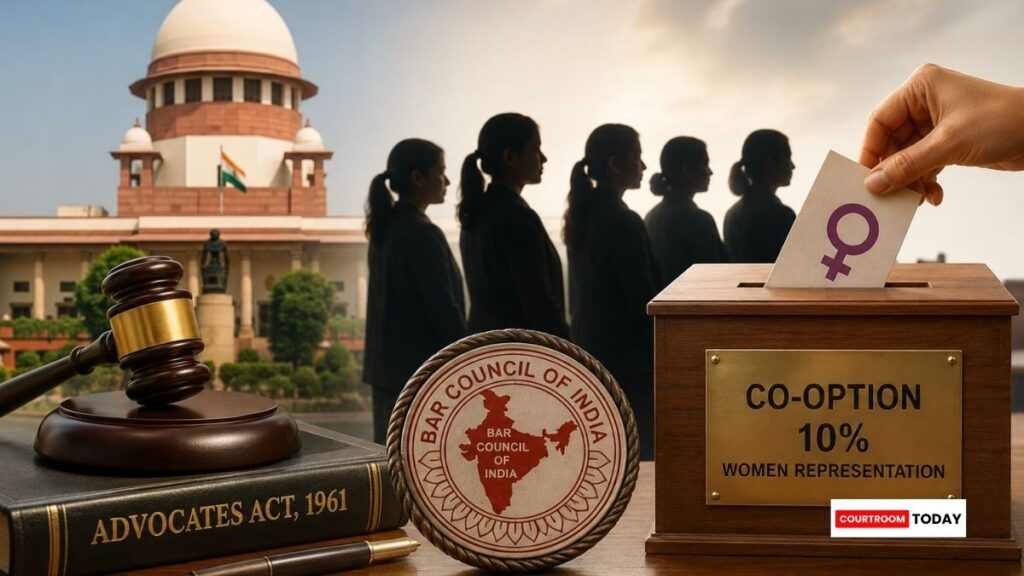
In M Vardhan v. Union of India, the Bar Council of India (BCI) has approached the Supreme Court seeking approval for a new mechanism to ensure women’s representation in State Bar Councils through co-option of women candidates who narrowly lost elections.
The application has been filed in the ongoing matter concerning 30% reservation for women in State Bar Council elections. The BCI has proposed that the 10% seats reserved for co-option should be filled by women candidates who secured the highest votes among those who were not elected.
According to the proposal, in councils where 25 members are elected, women candidates finishing in the 6th and 7th positions among unelected candidates would be co-opted. In councils with 20 elected members, candidates placed 5th and 6th would be considered. Similarly, in councils electing 15 members, the woman candidate placed 4th among unelected candidates would be co-opted.
The BCI argued before the Court that this process would maintain the democratic spirit of the Advocates Act, 1961 because the co-option would be based on votes already cast by advocates during elections.
The application states that selecting candidates based on vote count would make the process “fair, objective, transparent and least susceptible to arbitrariness.” The Bar body also said the mechanism would reduce allegations of favouritism or subjective selection.
According to the BCI, connecting co-option with actual electoral performance ensures that women representatives continue to have democratic backing from the legal fraternity while also promoting greater gender representation in State Bar Councils.
The BCI further informed the Court that the same proposal has been placed before the High-Powered Supervisory Committee headed by retired Supreme Court judge Justice Sudhanshu Dhulia, which is overseeing the election process.
The issue arises from the Supreme Court’s earlier directions mandating 30% reservation for women in State Bar Councils. In December 2025, the Court had directed Bar Councils to ensure such reservation. Later, in its April 13, 2026 order, the Court clarified that if sufficient women candidates were not elected directly, 10% seats could be filled through co-option.
The Supreme Court had also asked the supervisory committee to decide the manner in which such co-option should take place.
Referring to the April 13 order, the BCI stated that it has endorsed “option (a)” suggested by the Court, which recommended that co-option should be made from among contesting women candidates who secured the highest votes but could not get elected within the initial 20% reservation quota.
The BCI has now requested the Supreme Court to formally approve this mechanism for future implementation in State Bar Council elections.
——————————————–
Have a case update, article, or deal to share? Courtroom Today welcomes contributions from lawyers, law firms, and legal professionals. Write to contact@courtroomtoday.com