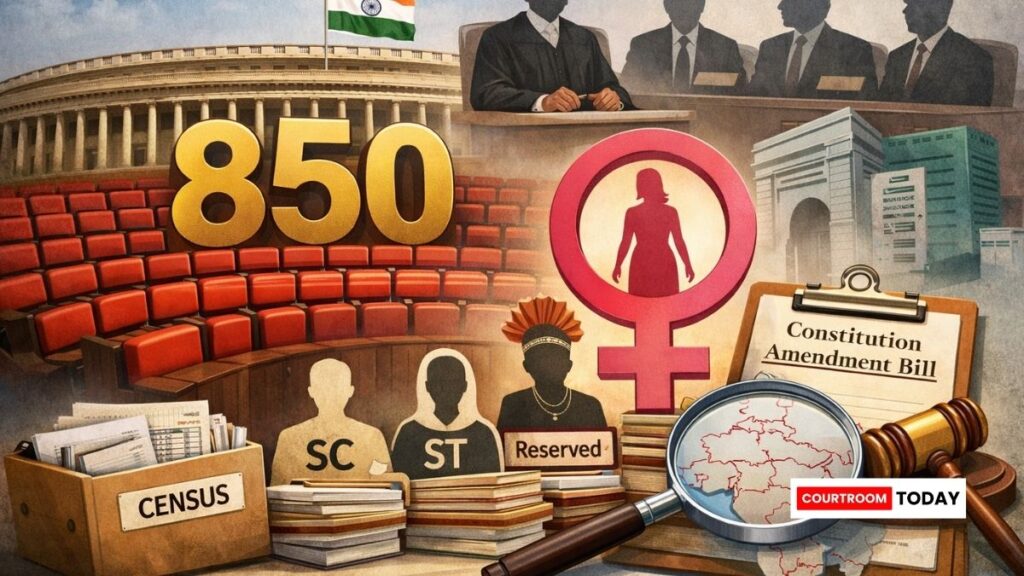
The Union Government has introduced The Constitution (One Hundred and Thirty First Amendment) Bill, 2026, proposing a major change in India’s parliamentary structure. The Bill seeks to raise the strength of the Lok Sabha from 543 to 850 members and is expected to be taken up during the Special Session of Parliament on April 16 and 17.
At the centre of the proposal is a change to Article 81. Under the new plan, up to 815 members would be elected from the States, while not more than 35 members would represent Union Territories. This marks one of the biggest proposed expansions of the House of the People since the Constitution came into force.
The Bill also seeks to amend Article 82, which deals with the readjustment of parliamentary constituencies after every Census. At present, the Constitution requires the next delimitation exercise to be based on the first Census conducted after 2026. The proposed amendment removes that requirement, allowing delimitation to be carried out without waiting for the post-2026 Census.
This proposed shift may have immediate political importance because it could speed up the implementation of women’s reservation in the Lok Sabha and State Assemblies. The Constitution (106th Amendment) Act, 2023 had tied the one-third reservation for women to a future delimitation exercise. The new Bill proposes to amend Article 334A so that the reservation can begin immediately after delimitation.
Alongside the amendment Bill, the Centre has also proposed the Delimitation Bill, 2026, which would replace the Delimitation Act, 2002. It provides for the creation of a Delimitation Commission through a government notification. The Commission would be chaired by a sitting or former Supreme Court judge and would include the Chief Election Commissioner, or a nominated Election Commissioner, along with the State Election Commissioner concerned.
For every State, ten associate members would assist the Commission, including five Members of Parliament and five MLAs nominated by the Speakers. These members, however, would not have voting rights. The Bill says the Commission would revisit Lok Sabha and Assembly seats, reserved seats for Scheduled Castes and Scheduled Tribes, and the boundaries of constituencies.
The proposed law further says constituencies should remain geographically compact and should consider administrative boundaries, communication facilities and public convenience. Once the Commission’s orders are published in the Gazette of India, they would have the force of law and cannot be challenged in court. Existing Houses and Assemblies, however, would continue until dissolution under the present framework.
——————————————–
Have a case update, article, or deal to share? Courtroom Today welcomes contributions from lawyers, law firms, and legal professionals. Write to contact@courtroomtoday.com