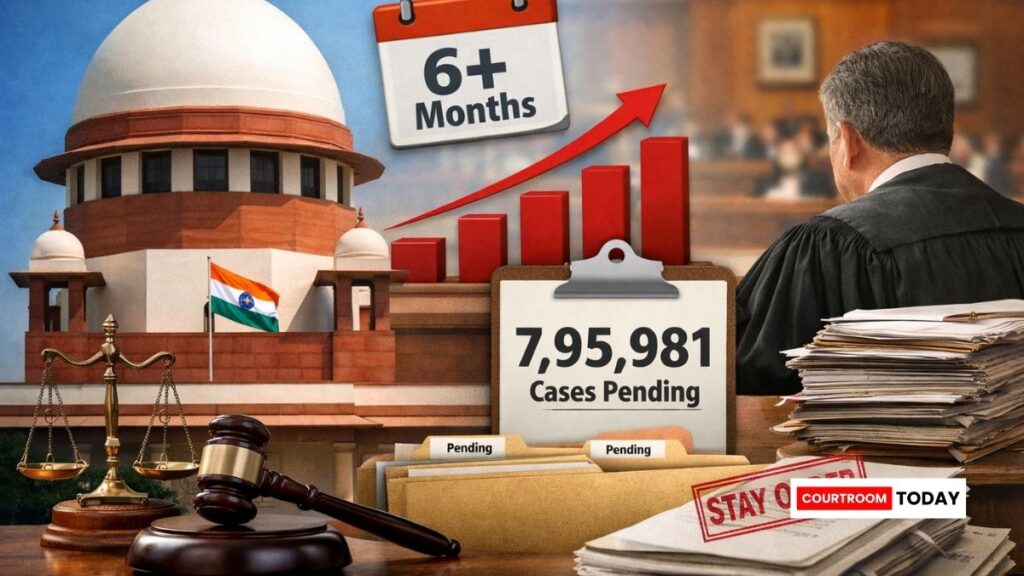
The Supreme Court in Periyammal (Dead) Through LRs & Ors. v. V. Rajamani & Anr. has raised serious concern over the mounting backlog of execution petitions across the country. It described the situation as alarming, noting that a large number of such cases remain unresolved beyond six months.
The Court observed, “The position as on date appears to be very frightening and disappointing. We say so because as on date 7,95,981 execution petitions are pending across the country which are six months old”. This remark highlights the growing concern over delays in enforcing judicial decisions.
A Bench of Justice JB Pardiwala and Justice Pankaj Mithal directed all High Courts to submit details regarding mechanisms developed to ensure timely disposal of execution petitions. The Court has sought a clear framework to address delays and improve the efficiency of the system.
The Court ordered, “By the next date of hearing i.e. 07.10.2026, each of the High Courts shall let us know in brief as regards the mechanism evolved or the type of directions issued to their respective district judiciaries for effective and speedy disposal of the execution petitions”.
This matter arises from ongoing monitoring by the Supreme Court to ensure compliance with its earlier directions on time-bound disposal. Earlier data from October 2025 showed pendency of over 8.82 lakh execution petitions, which the Court had termed alarming and unacceptable.
While some progress has been recorded, the backlog continues to remain significant. Between March 2025 and April 2026, over 7.69 lakh execution petitions were disposed of. Despite this, nearly 8 lakh cases still remain pending beyond six months, indicating systemic delays.
The Court also reviewed state-wise figures, which revealed substantial pendency across several jurisdictions. Maharashtra alone accounts for nearly 3.95 lakh pending execution petitions. Karnataka, Madras, Kerala, Andhra Pradesh, and Madhya Pradesh also show high volumes of pending matters.
Additionally, the Court noted that a considerable number of cases are stayed by superior courts, further contributing to delays. It specifically requested Chief Justices of certain High Courts to prioritise such stayed matters and ensure that execution proceedings are not unnecessarily prolonged.
Fresh filings also continue to add to the burden. Several High Courts, including Bombay, Kerala, Karnataka, and Delhi, have witnessed a high inflow of new execution petitions. This trend indicates that disposal rates must significantly improve to prevent further backlog.
The Supreme Court has scheduled the matter for further hearing on October 7, 2026. It has also directed that its order be circulated to all High Courts, signalling the need for coordinated and immediate action across the judiciary.
——————————————–
Have a case update, article, or deal to share? Courtroom Today welcomes contributions from lawyers, law firms, and legal professionals. Write to contact@courtroomtoday.com